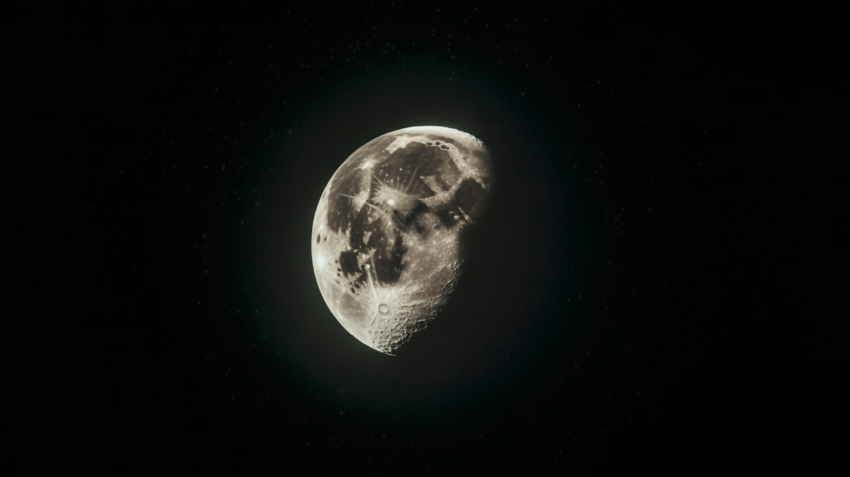
Everyone pays attention to the full moon. She gets the rituals, the Instagram posts, the breathless captions. And then she starts to shrink, and everyone moves on.
The waning gibbous moon is the phase directly after the full moon. Still bright. Still commanding. Still more than half lit. And almost nobody gives her the time of day.
I find this telling, because in twenty years of tracking lunar cycles against my own life and my clients’ lives, the waning gibbous is where the most important spiritual work actually happens. The full moon reveals. The waning gibbous asks you what you’re going to do with what you saw.
If you’ve ever felt strangely hollow in the days following a full moon, you’ve felt this energy. If you’ve had a moment of searing clarity under the full moon and then watched yourself slowly talk yourself out of it over the next week, you’ve lived through the waning gibbous lesson. And if you were born during this phase, you carry its signature in your blood.
Let’s talk about what that means.
What Is the Waning Gibbous Moon?
The waning gibbous is the sixth of eight lunar phases. After the moon reaches full illumination, she begins her descent. When the lit portion shrinks from 99.9% to 50.1%, you’re in the waning gibbous. It lasts roughly seven days and ends at the third quarter half moon.
“Waning” comes from the Old English wanian, to lessen. “Gibbous” from the Latin gibbosus, swollen or humped. Together they describe a moon that looks almost full to the casual eye but is already losing light if you know where to look.
She rises late at night and stays visible well into the morning. If you’ve ever seen a large, luminous moon hanging in the early sky while the sun is already coming up, that was likely the waning gibbous. She keeps company with the quiet hours. She’s a dawn moon, a companion for people who are awake when they probably shouldn’t be.
Here’s the visual that carries the entire teaching: she looks almost full. You could easily mistake her. The difference is a soft shadow creeping in from one side, barely perceptible unless you’re paying attention. And that subtlety is the point.
The Core Spiritual Meaning
Search for this topic online and you’ll find the same three words repeated everywhere: release, let go, reflect. True enough. And completely insufficient.
The astrologer Dane Rudhyar, whose 1967 book The Lunation Cycle remains the most significant text on lunar phases in Western astrology, didn’t call this the “waning gibbous” at all. He called it the Disseminating Moon. That word changes everything.
Disseminate. To spread, scatter, distribute. Think of a flower that has reached full bloom and is now releasing its seeds into the wind. The flower isn’t dying. It’s doing exactly what it was always designed to do. The blooming was the spectacle. The seeding is the purpose.
Rudhyar wrote that after the full moon’s revelation, “form gradually releases its meaning as the Moon decreases in light. The waning period is a period of growth for the active power of consciousness.” Read that again slowly. He said growth. During the waning.
This reframes the entire phase. You aren’t winding down. You are distributing. Whatever the full moon illuminated in your life, the waning gibbous is when you absorb its significance and begin sharing it. Teaching it. Living it forward.
Demetra George expanded on this beautifully in her own work on lunar phases. She described this phase as corresponding to peak productivity in the human life cycle, when experience and maturity more than compensate for waning stamina. The fruit is heavy on the branch. It wants to be picked. It wants to feed someone.
So the spiritual meaning of the waning gibbous moon lives in three movements. Gratitude for what was revealed. Honest processing of what you saw. And the courage to share what you’ve learned, even when the learning left marks.
That last one is where most people go quiet.
The Shadow Side
I’m going to be direct with you here, because the spiritual wellness internet will not be.
The waning gibbous is emotionally hard. For many people, it’s the hardest stretch of the entire lunar cycle. The reason is simple and old: the party’s over. Your body knows it. Your mind hasn’t caught up.
Here’s what I see happen, in my own life and in the lives of the hundreds of people I’ve walked through lunar cycles with over the years:
The full moon hangover is real. The full moon is intense. Emotions crest, decisions get made, things come to the surface that have been hiding for weeks. Then the waning gibbous arrives and you wake up feeling flat. Deflated. Confused about whether what happened at the full moon was genuine insight or just heightened emotion. This is normal. This is the energetic morning-after.
Clinging shows up wearing spiritual language. The waning gibbous asks you to release, and your psyche responds by gripping tighter. I’ve watched clients hold onto relationships, habits, and beliefs they clearly named as finished during the full moon, then spend the entire waning gibbous talking themselves back to sleep. “Maybe I was overreacting.” “Maybe it’s not that bad.” “Maybe I should give it one more try.” If you have ever had an insight you couldn’t act on, this phase is usually why.
Grief arrives uninvited. Letting go sounds clean and elegant on a Pinterest board. In lived experience, it involves mourning. Even when you’re releasing something that needed to go, there’s a sadness that has a right to be there. The waning gibbous holds that sadness. The moon is visibly losing her light, and something in your chest echoes that loss whether you invited it or not.
Exhaustion. The full moon burns energy. The waning gibbous sends the invoice. If you’ve been running at full intensity since the new moon, this is when your body stops asking and starts demanding. Irritability, vivid or strange dreams, restless sleep, a tiredness that sits behind your eyes and doesn’t respond to caffeine.
None of this is a problem. All of it is the teaching. If you can sit with the discomfort of waning, if you can feel the loss of light without trying to fix it or pretend it isn’t happening, you develop something rare and genuinely useful. You develop the capacity to be at peace with things ending. And that capacity will serve you for the rest of your life in ways I cannot overstate.
The Waning Gibbous in Myth and Tradition
Across cultures, this phase carries the energy of the wise elder. The one who has seen the peak and now carries its knowledge forward in her body.
In the Triple Goddess framework central to Wiccan and Pagan traditions, the waning gibbous marks the threshold into the Crone. The Mother’s generative fullness (the full moon) gives way to the Crone’s distilled wisdom. The Crone is never diminished. She is concentrated. Everything unnecessary has been burned away, and what remains is authority that can only come from having lived through something and survived it.
In Yoruba and Santería traditions, the waning gibbous is associated with the Orisha Ochosi, the god of hunting and justice. Ochosi is precise. His energy asks: did you hit your mark? What needs adjusting before the next aim? This phase is also connected to Oya, the fierce guardian of transformation, whose winds sweep away everything that has gone stagnant. Practitioners often work with spiritual baths during the waning moon, using cascarilla, coconut water, and Florida Water to cleanse and protect the spirit.
In Hindu astrology, the waning fortnight is called Krishna Paksha, and it is honored as profoundly powerful for inward work. Meditation, fasting, certain spiritual observances belong specifically to this darkening period. The logic is beautiful in its simplicity: as external light decreases, the conditions for internal illumination improve.
And across folk and agricultural traditions worldwide, the waning gibbous was simply recognized as the first phase of harvest. The crop has peaked. Now you gather. You sort. You share what grew.
The Waning Gibbous in Astrology
During this phase, the moon sits between 225° and 270° behind the sun. Two aspects shape this range: the waning sesquiquadrate (225°) and the waning trine (240°).
The sesquiquadrate is friction. A minor hard aspect that produces restlessness, agitation, the nagging sense that something needs adjusting. This is why the first few days after a full moon often feel uneasy. Something is rubbing, and you can’t quite name it yet.
As the phase deepens toward the trine, the energy shifts. The trine is flow. Communication, connection, the sudden ability to articulate things that were formless three days earlier. This is where the disseminating quality truly activates. Ideas land. Conversations open. You find words for experiences that were mute during the full moon’s glare.
The zodiac sign the moon occupies during her waning gibbous phase makes a significant difference. A waning gibbous in Cancer pulls you deep into emotional processing and ancestral patterns. In Capricorn, the energy turns toward practical restructuring and honest career review. In Gemini, you’ll talk and write and process until you’ve turned every stone twice. In Scorpio, the shadow material surfaces fast and raw, and there is no pleasant way through it, only the direct way.
If you’re serious about working with the moon, start tracking the sign the waning gibbous falls in each month. After four or five cycles, you’ll feel the patterns before you check the calendar. Your body will know before your phone does.
Born Under a Waning Gibbous Moon
If you were born during this phase, everything I’ve described lives in your bones. It’s been there since your first breath.
The single most consistent trait across every source, every tradition, and every client chart I’ve read: you seem wise beyond your years. People have been telling you this since you were small. You’ve always been the one who sees the situation for what it is while everyone else is still reacting. You process fast, learn from experience faster than almost anyone around you, and distill complex situations into their essential truth with an ease that can unsettle people who aren’t ready for that kind of clarity.
Rudhyar and Demetra George both identified the waning gibbous birth type as carrying the archetype of the teacher. Your purpose involves conveying awareness. Sharing messages that matter. Passing on wisdom that came to you through experience, through your skin and your mistakes, never through theory alone. You leave lasting impressions on people. There’s an objectivity in you that sees the whole picture when everyone else is zoomed in on one corner.
You are also, if you’re honest, someone who has struggled with being understood. Your intelligence can land as arrogance. Your clarity can feel like confrontation to people who prefer comfortable vagueness. You may have spent years confused about why others don’t learn as quickly from their mistakes as you do. One of your core lessons is accepting that your speed is a gift and that the world is not obligated to keep pace.
In love, you’re layered. You live across a wide spectrum, from deep devotion to consuming passion. You explore. You’re open. Sometimes dangerously so. When you find genuine love, you’re capable of extraordinary loyalty and sacrifice. When you’re betrayed, something in you goes cold in a way that can take years to thaw. You keep quiet accounts, even when you’d rather not. The lesson here is old and simple: balance. Learn the difference between a love that transforms you and a love that just burns.
Your career instincts are sharp. Entrepreneurial, ambitious, quick to master new skills. You say what you mean, and depending on the room, that’s either your greatest asset or the thing that makes people avoid you at meetings. You’re at your best when you’re teaching, mentoring, writing, sharing expertise. Roles that ask you to translate raw experience into wisdom people can actually use will always feel like home.
Your deepest challenge, and I say this gently: the feeling that something is missing. Waning gibbous souls carry a low, persistent hum of incompleteness. You’ve felt it your whole life. It drives your seeking, your learning, your restless self-improvement. It can also drive you to fill the void with things that don’t deserve you. The spiritual work, the real work, is reconnecting your intellect with your spirit. You have a brilliant mind. But your heart knows things your head hasn’t caught up to. It always has.
Waning Gibbous Moon and Love
During the waning gibbous phase each month, relationships enter a period of honest reckoning. The full moon’s intensity has passed. The question on the table is no longer “do I feel something?” It’s “what did I learn about this connection when everything was illuminated, and am I brave enough to act on it?”
For couples, this is a powerful window for the conversations you’ve been circling for weeks. The waning gibbous supports honesty that’s firm and clean without being unkind. If you noticed something important about your relationship during the full moon, this is the phase to say it out loud. The energy favors resolution over performance.
For singles, the waning gibbous brings focus. Full moon energy is expansive and sometimes blinding. This phase sharpens your vision. You might realize the person who dazzled you at the full moon isn’t what you actually need. Or you might realize they’re exactly what you need and you’ve been building walls to keep them at arm’s length. Either way, this moon asks for honesty about your own patterns.
The waning gibbous in love is best captured in one word: realistic. This phase favors connections that are fair, reliable, and grounded in something real. If that sounds boring to you, it may be worth sitting with why. The waning gibbous knows the difference between intensity and depth. She always has.
Rituals for the Waning Gibbous Moon
This phase doesn’t want elaborate ceremony. She wants sincerity and precision.
The Full Moon Debrief. Within a day or two of the full moon, sit with your journal and answer four questions. What did the full moon show me that I wasn’t expecting? What showed up that I asked for? What showed up that I didn’t? And what am I resisting releasing? Be specific. Names, feelings, the situation as it actually is. The power is in the specificity. Vague intentions produce vague results.
The Gratitude Inventory. This is different from a gratitude list. During the waning gibbous, practice gratitude for what hurt. The lesson inside the project that failed. The clarity hidden in the argument. The strange relief inside the door that closed. This is gratitude as reckoning. You look at the losses of the past cycle and you find the teaching hidden inside them, and you say thank you to the teaching even if the loss still stings.
The Teaching Practice. Drawn from the Disseminating Moon archetype: identify one thing the last two weeks taught you, and share it. A conversation, a message, a post, a letter to someone who needs to hear it. The energy of this phase is movement outward. Hoarding wisdom during a waning gibbous works against the current. What you’ve learned wants to move through you and into the world. Let it.
The Dawn Sit. The waning gibbous is visible in the early morning sky. On a clear morning during this phase, rise before the sun does. Go outside or sit where you can see her. Don’t meditate in any formal way. Just sit with the visual reality of a moon that is still luminous and already leaving. Practice being at peace with enough. The fullness has passed. What remains is still beautiful. Let that truth settle somewhere in your body where you’ll remember it on the days you need it most.
Crystals for this phase: Black tourmaline and smoky quartz for grounding and breaking old patterns. Rose quartz for tenderness toward yourself during the release. Rhodonite for emotional healing. Labradorite for the courage that transformation requires. Lepidolite for easing the anxiety that lives inside letting go.
Herbs: Mugwort for intuition and dream work. Rosemary for purification. Lavender for rest. Lemon balm for calming transitions. White sage for clearing what’s grown stale.
Essential oils: Cypress, frankincense, lavender, bergamot, clary sage. A few drops in a warm bath, or diffused into the room during your evening hours.
One Last Thing
The waning gibbous moon is still so bright. That’s the detail everyone misses. She is losing light, yes. She is past her peak, yes. And she still illuminates the ground beneath your feet. She still casts shadows. You can still find your way by her.
There’s a teaching in that I keep returning to, year after year, cycle after cycle. The peak is never the only valuable part. The descent carries its own beauty, its own purpose, its own quiet ferocity. The seeds scatter in the waning. Next month’s garden depends entirely on what gets released now.
Pay attention to her. She’s been waiting.
Also read: Waxing Gibbous Moon Spiritual Meaning: The Sacred Art of Almost
Also read: Waning Crescent Moon Spiritual Meaning: The Most Powerful Phase Nobody Talks About