Everyone obsesses over the full moon. Social media lights up with full moon rituals, full moon manifestation posts, full moon this, full moon that. Meanwhile, the waning crescent moon quietly slips through the pre-dawn sky and almost nobody pays attention.
That’s a mistake.
After twenty years of tracking lunar cycles in my own life and in the charts of hundreds of clients, I can tell you something with absolute confidence: the waning crescent moon spiritual meaning runs deeper than any other phase. This is where the real transformation happens. The full moon gets the glamour. The waning crescent does the work.
What Exactly Is the Waning Crescent Moon?
The waning crescent is the final visible phase of the lunar cycle. After the full moon peaks and begins to shrink, it passes through the waning gibbous and third quarter until only a thin sliver of light remains on the left side of the moon. That sliver is the waning crescent.
It lasts roughly three to four days before the moon disappears entirely into the new moon.
Here’s a detail most spiritual writers miss: the waning crescent moon rises in the pre-dawn hours. While you’re deep in your most vivid dreams, this moon is climbing the sky. That timing matters. It tells you something about the nature of this phase. It operates in the spaces between waking and sleeping, between one cycle ending and another beginning. It does its best work when your conscious mind steps aside.
The Spiritual Meaning of the Waning Crescent Moon
The waning crescent moon spiritual meaning centers on five interconnected energies: release, rest, reflection, forgiveness, and preparation.
Release is the headline everyone knows. Let go of what no longer serves you. Fine. But there’s a subtlety here that gets lost in the Instagram captions. You can’t release what you haven’t fully acknowledged. The waning crescent doesn’t ask you to toss things away like spring cleaning. It asks you to sit with what you’re holding, understand why you held it so long, and then consciously set it down.
Rest during this phase is non-negotiable. Your energy is naturally lower. If you’ve been pushing through, your body will start making demands. Canceling plans during the waning crescent isn’t laziness. It’s intelligence. You are working with the current instead of swimming against it.
Reflection here takes on an observer quality. You’re not analyzing your life to fix it right this second. You’re watching it from a slight distance, noticing which areas feel harmonious and which feel strained. Think of it as taking a wide-angle photograph of your inner landscape before the new moon wipes the lens clean.
Forgiveness is the aspect that surprises people. The waning crescent is one of the most potent times in the entire lunar cycle for forgiveness work, both toward yourself and toward others. The natural momentum of release makes it easier to loosen your grip on old resentments. They’re ready to go. You just have to let them.
Preparation is the piece that separates intentional moon work from passive observation. Everything you release and process during the waning crescent creates space. That space is where your new moon intentions will land. Skip this phase and your new moon goals are trying to grow in soil that’s still full of last season’s roots.
The Balsamic Moon: What Astrologers Actually Call This Phase
In astrological tradition, the waning crescent carries a more evocative name: the balsamic moon. Astrologer Dane Rudhyar popularized the term in his 1967 book The Lunation Cycle, and it stuck for good reason.
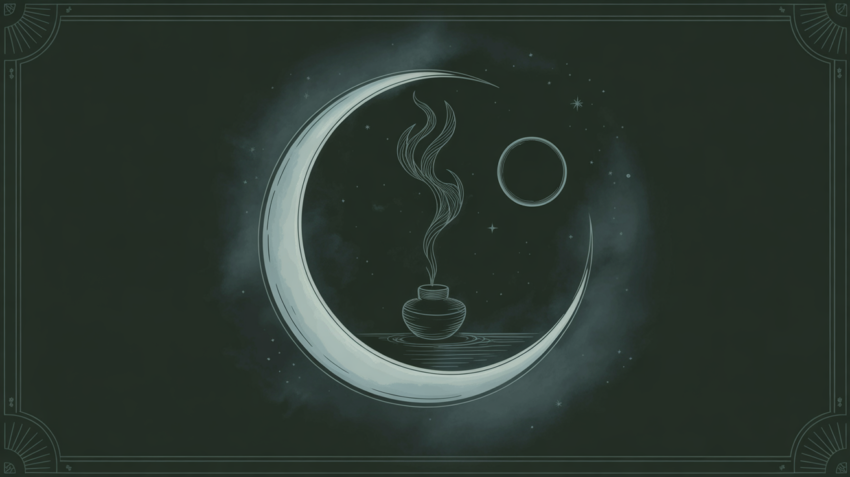
“Balsamic” comes from “balsam,” an aromatic resin burned as incense. Steven Forrest later described this phase as “incense rising up from the altar to the realm of the gods and goddesses.” I’ve always loved that image. Something material dissolving into smoke, becoming formless, ascending. That is precisely what happens to us energetically during the waning crescent.
Astrologically, the balsamic moon is associated with Neptune: the planet of imagination, dreams, spiritual dissolution, and the loss of illusions. The veil between your conscious and unconscious mind gets thinner here. Instinct and intuition spike. Right-brain processes have been gathering strength since the full moon, and they peak during this phase.
This is also why the balsamic moon corresponds seasonally to Samhain (Halloween) in the Wheel of the Year. Same energy. The veil thins. The ancestors feel closer. Things that were hidden become perceptible.
If you’ve ever felt oddly emotional, strangely perceptive, or unusually drained in the few days before a new moon, now you know why.
The Waning Crescent in Ancient Mythology
The ancients understood this phase far better than our modern moon obsession gives them credit for.
In Greek mythology, the waning crescent belonged to Hecate: goddess of magic, crossroads, and the night. Hecate was no gentle lunar maiden. She ruled the liminal spaces, the places where paths diverge, where the seen meets the unseen. She held torches in the darkness and demanded you face what was hiding there. The waning crescent carries that same energy. It meets you at the crossroads and asks: which version of yourself are you leaving behind?
The Sumerians told an even older story. They associated the waning crescent with Inanna’s descent into the underworld, where the great goddess had to pass through seven gates, surrendering a piece of her identity at each one. By the time she reached the bottom, she was stripped bare. And from that place of total surrender, she was reborn.
That myth is the waning crescent. Every lunar cycle offers you a miniature version of Inanna’s descent. The question is whether you’ll walk through the gates willingly.
In Egypt, the waning crescent connected to Thoth, god of wisdom, writing, and the moon itself. The keeper of sacred knowledge. Which tracks perfectly: this phase rewards those who journal, who write through their feelings, who trust that putting ink on paper is its own form of magic.
And in the Triple Goddess tradition, the waning crescent represents the Crone. The Maiden waxes. The Mother is full. The Crone wanes. She holds the wisdom of the entire cycle, the perspective that only comes from having lived through every phase. The Crone is often misunderstood as diminished. She is the most powerful of the three.
Shadow Work and the Gift of Darkness
Here’s where I’m going to be direct with you.
The internet is full of waning crescent content that stays relentlessly positive. Release with love! Let go with gratitude! Surrender and trust!
And yes, those things are real. But the waning crescent also surfaces your shadow. The parts of yourself you don’t post about. The patterns you keep repeating. The fears you’ve decorated so well you’ve forgotten they’re fears.
The darkness of this phase isn’t metaphorical decoration. When the moon’s light is almost gone, your inner world gets louder. Emotions you’ve been outrunning catch up. Thoughts you’ve been avoiding find their way in. Dreams get strange and pointed.
This is a feature, not a problem.
The waning crescent spiritual meaning includes an invitation to let your shadow speak. What are you afraid of? What keeps showing up in your life no matter how many times you try to “release” it? What would happen if you stopped trying to fix that pattern and just listened to what it’s telling you?
Shadow work during the waning crescent is unusually productive because the phase itself is doing half the work. The unconscious material is already closer to the surface. You don’t have to dig as deep.
Born Under a Waning Crescent Moon
If you were born during the waning crescent phase, your entire personality carries the signature of this energy.
You are almost certainly what people call an old soul. You arrived with a kind of knowing that has nothing to do with experience or education. You sense things before they happen. You read people accurately within minutes of meeting them. You’ve probably been told you’re “wise beyond your years” since childhood.
Your intuition is genuinely exceptional. You may have psychic experiences, prophetic dreams, or a persistent sense that there’s more going on beneath the surface of reality than most people acknowledge. This is your wiring. The balsamic moon birth imprint gives you an unusually thin boundary between conscious and unconscious perception.
Creatively, you’re likely prolific in ways you may not fully appreciate. Art, writing, music, any medium that lets you channel your rich inner world outward. Dana Gerhardt, one of the finest lunation astrologers working today, made an observation about balsamic moon people that has stuck with me for years: “You rarely understand just how creative and intuitive you are. You think that your way of being and processing is normal. But you’re special.”
The challenge? You feel different. You always have. You may have spent years trying to fit yourself into frameworks that don’t quite work for you. Relationships can be intense and short-lived, carrying a karmic quality, like you’re meeting people to complete unfinished business rather than building something conventional. Astrologer Demetra George observed this pattern specifically in balsamic moon births: a series of brief, powerful encounters that serve a purpose and then dissolve.
Your power day each month is the waning crescent. Pay attention to how you feel during this phase. You may notice a surge of clarity or energy that contradicts the “low energy” advice everyone else is getting.
Rituals for the Waning Crescent Moon
Keep it simple. This phase doesn’t want elaborate ceremony. It wants sincerity.
Journaling for Release
Grab a pen. Actual paper, actual ink. Write down everything you’re carrying that feels heavy. Don’t edit yourself. Don’t aim for eloquent. Just dump it out.
Then ask yourself these questions:
- What did I learn this lunar cycle that I want to carry forward?
- What am I still holding that I already know I need to set down?
- Where am I resisting a change that’s trying to happen?
- Who or what do I need to forgive, including myself?
- How do I want to feel when the new moon arrives?
The Release Burn
Write what you’re releasing on individual slips of paper. Be specific. “I release the belief that I’m not good enough for that promotion” hits harder than “I release negativity.” Light each slip in a fireproof dish. Watch the smoke rise. Think of Rudhyar’s balsam incense ascending to the gods. That’s what you’re doing.
Ritual Bath
Combine sea salt and Epsom salt in warm water. Tie lavender, rosemary, or sage in a cloth and let it steep in the bath. Light a candle. Put your phone in another room. Spend at least thirty minutes soaking. As you drain the tub, visualize everything you’re releasing going with the water.
Pre-Dawn Meditation
If you’re willing to set an alarm, there is nothing quite like meditating during the waning crescent’s actual moonrise. Sit quietly in the dark with your eyes closed. Don’t try to empty your mind. Just listen. The insights that come during pre-dawn waning crescent meditation tend to be remarkably clear.
Dream Work
Place a journal beside your bed. Before sleep, set the intention: “Show me what I need to see.” The waning crescent is one of the strongest phases for meaningful dreams. Write down whatever you remember immediately upon waking, even fragments. Patterns will emerge over time.
If you want to amplify this, tuck a small sachet of dried mugwort under your pillow. Mugwort has been the go-to moon herb for lucid dreaming across multiple traditions.
Crystals, Herbs, and Correspondences
Crystals for the Waning Crescent
Amethyst is your anchor stone here. Calming, spiritually clarifying, and perfect for meditation. Place it on your nightstand or hold it during reflection work.
Lepidolite promotes emotional balance and helps release old patterns. Especially useful if you feel stuck in loops.
Black moonstone amplifies lunar intuition while grounding you in the process. My personal favorite for this phase.
Selenite clears stagnant energy and resets your field. Run a wand over your body from head to toe before sleep.
Rose quartz for self-compassion. The waning crescent asks a lot of you emotionally. Rose quartz keeps the work gentle.
Herbs and Aromatherapy
Lavender calms the nervous system and supports release. Tea, essential oil, bath sachet, or dried bundles.
Mugwort is the quintessential moon herb. Enhances dreams, boosts intuition, supports divination work.
Chamomile promotes the deep rest this phase demands.
Frankincense is the scent of the balsamic moon itself. Ancient, spiritual, and specifically supportive of forgiveness work. Burn it as resin, diffuse the oil, or anoint a candle.
Sage purifies and clears. Use it to cleanse your space before and after ritual work.
Colors
Black, deep indigo, silver. These are the colors of the dark that’s about to arrive. Wear them, surround yourself with them, let them signal your intention to go inward.
How to Honor the Waning Crescent in Daily Life
You don’t need a full altar setup to work with this moon phase. You can honor it in completely ordinary ways.
Slow down your schedule. Say no to at least one thing you’d normally say yes to. Sleep an extra hour. Take a longer shower and let the water carry some weight off your shoulders. Clean out one drawer, one shelf, one corner of a room. Unsubscribe from emails that no longer interest you. Delete apps you haven’t opened in months. Eat warm, nourishing food. Drink tea instead of your third coffee.
The waning crescent spiritual meaning, at its core, is about trusting the dark. Trusting that rest is productive. Trusting that endings make room for beginnings. Trusting that the most important work often happens when you stop doing and simply allow.
The new moon is coming. When it arrives, you’ll be ready. Because you gave yourself this time in the quiet, in the dark, in the last thin light of the crescent. And that changes everything.