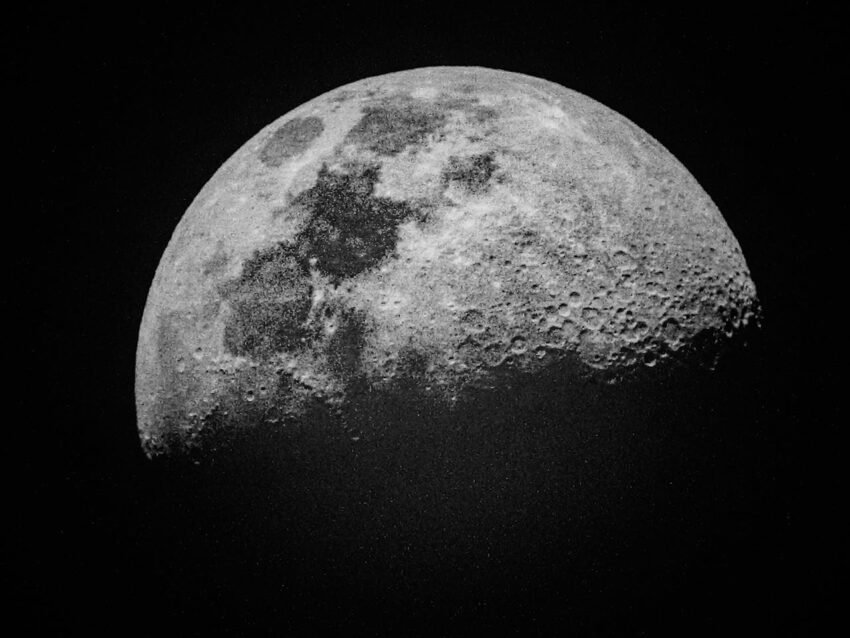
Something strange has been happening on the lunar surface for centuries. And science still doesn’t have an answer.
I’ve spent twenty years studying the moon. Her cycles, her pull on our tides and emotions, her quiet influence on everything from sleep patterns to menstrual cycles. But here’s what I keep coming back to: the moon isn’t as dead as we’ve been told.
For centuries, astronomers have reported brief, unexplained events on the lunar surface. Flashes of light. Red and violet glows. Strange mists that appear and vanish within hours. These are called Transient Lunar Phenomena, or TLPs. NASA has cataloged over 1,400 of them. We still don’t know what causes them.
This isn’t fringe science. This isn’t wishful thinking. This is documented history, observed by some of the greatest astronomers who ever lived.
The Night Five Monks Watched the Moon “Split in Two”
On June 18, 1178, five monks in Canterbury, England, looked up at the crescent moon and witnessed something that would haunt astronomical debate for the next 850 years.
According to Gervase, the abbey’s chronicler, the men saw the moon’s upper horn “suddenly split in two.” What followed sounds almost apocalyptic:
“From the midpoint of the division a flaming torch sprang up, spewing out fire, hot coals and sparks. Meanwhile the body of the Moon which was below writhed, as it were in anxiety… the Moon throbbed like a wounded snake.”
The phenomenon repeated a dozen times before the moon “took on a blackish appearance.”
In 1976, geologist Jack Hartung proposed a wild theory: the monks had witnessed a massive asteroid impact that created the Giordano Bruno crater, a 22-kilometer scar on the moon’s far side that’s suspiciously young by lunar standards.
The problem? An impact that size would have ejected 10 million tonnes of debris toward Earth, triggering a week-long meteor storm visible across the entire planet. No Chinese, Arabic, Japanese, or Korean astronomical records mention anything of the sort.
The current thinking? Those five monks were probably in exactly the right spot to see a meteor burning up in Earth’s atmosphere, directly in front of the moon, at precisely the right angle to create the illusion of lunar chaos.
But we can’t be certain. And that uncertainty is what makes TLPs worth paying attention to.
Aristarchus: The Moon’s Most Haunted Crater
If you want to see something strange on the moon, point your telescope at Aristarchus.
This 40-kilometer crater in the Ocean of Storms is the brightest feature on the entire lunar surface. So bright that William Herschel, the astronomer who discovered Uranus, mistook it for an active volcano in 1783. He wasn’t seeing lava. He was seeing the first reliably documented TLP in modern astronomy: a red glow emanating from a crater on the unilluminated side of the moon.
Herschel was so convinced of what he’d witnessed that he invited King George III to look through the royal telescope himself.
Since then, Aristarchus has become ground zero for lunar weirdness. Over 122 TLP reports have been logged at this single location, more than any other lunar feature. One-third of all reliable TLP sightings in history come from Aristarchus and its immediate surroundings.
What observers describe varies: electric-blue halos, red and amber glows, periodic obscurations, cloud-like features that don’t persist. Some have watched the crater’s central peak flash brilliant white before fading to normal.
The reports span centuries. They come from amateurs and professionals alike. And they keep coming.
“Houston, I’m Looking at Aristarchus Now…”
On July 19, 1969, just hours before the Eagle would land on the Sea of Tranquility, Mission Control radioed Apollo 11 with an unusual request.
Amateur astronomers in Germany had reported a TLP near Aristarchus. Could the crew take a look?
Neil Armstrong gazed out his window and responded:
“Hey, Houston, I’m looking north up toward Aristarchus now, and there’s an area that is considerably more illuminated than the surrounding area. It just has… seems to have a slight amount of fluorescence to it.”
He wasn’t certain he was looking at the right crater. But he saw something.
Three years later, during Apollo 17, Harrison Schmitt observed a bright flash near the crater Grimaldi while in lunar orbit. Command Module Pilot Ronald Evans saw another flash east of Mare Orientale.
These weren’t wide-eyed mystics. These were NASA astronauts, trained observers, looking at the moon from 60 miles above its surface.
So What’s Actually Happening?
I’ll be straight with you: nobody knows for sure.
The leading theories fall into four categories, and none of them fully explains everything observers have reported.
Outgassing is currently the most scientifically supported explanation. The idea is that pockets of gas, particularly radon, occasionally escape through cracks in the lunar surface, producing visible effects as they interact with sunlight. This theory got a significant boost when the Lunar Prospector mission detected radon-222 emissions from Aristarchus and Kepler craters. The correlation between TLP hotspots and radon detection sites is hard to ignore.
Meteorite impacts account for some TLPs, particularly the brief flashes that last milliseconds. We’ve recorded hundreds of these impact events on video since 2005, many associated with meteor showers. But impacts don’t explain the hours-long glows and color changes.
Electrostatic phenomena offer another possibility. When the sun’s charged particles hit the lunar surface, they may ionize dust particles, kicking them into enormous clouds that scatter light in unusual ways. Some researchers believe this could explain the hazes and mists observers have reported.
Observer error is, frankly, part of the picture. Earth’s atmosphere distorts everything we see. Satellites cross the lunar disk. Exhausted astronomers hallucinate after long nights at the telescope. Skeptics argue that most TLPs are nothing more than atmospheric aberrations or wishful thinking.
But statistical analysis of TLP reports shows something worth noting. Certain sites produce consistent reports across centuries, regardless of who’s observing or what equipment they’re using. Aristarchus. Plato. The young impact craters Copernicus and Tycho. The robustness of these patterns suggests something real is happening, even if we can’t yet say what.
The Moon We Thought We Knew
For most of the 20th century, the scientific consensus was clear: the moon is geologically dead. A frozen relic. Nothing has happened on its surface for over three billion years.
TLPs challenge that narrative.
If gas is escaping from the lunar interior, the moon isn’t quite as inert as we assumed. If electrostatic phenomena are producing visible light shows, the interaction between the sun and lunar surface is more dynamic than we thought. Either way, our supposedly barren satellite is still doing something.
The British Astronomical Association and the Association of Lunar and Planetary Observers continue to coordinate TLP observation programs today. Amateur astronomers around the world still watch the same craters that Herschel watched in 1783, looking for the same unexplained lights.
They’re not looking for aliens. They’re not chasing ghosts. They’re documenting a phenomenon that science acknowledges exists but cannot fully explain.
What I Think About at 3 AM
I won’t claim to know what TLPs are. I’m not a geologist or a planetary scientist. I’m someone who has spent decades watching the moon, learning her rhythms, teaching others to pay attention to her cycles.
But I’ll tell you what gets me about TLPs: the moon has been trying to get our attention for 850 years, and we’re only just starting to listen.
We sent twelve men to walk on her surface. We left seismometers and retroreflectors. We collected 842 pounds of rock and brought it home. And still, she keeps surprising us.
The next time you look up at a clear night sky, find Aristarchus. It’s in the upper left quadrant of the moon’s face, unmistakably bright even without a telescope. And know that for centuries, people have watched that spot and seen things they couldn’t explain.
Maybe you will too.
Have you ever witnessed something unusual on the lunar surface? I’d love to hear about it. Drop me a note in the comments or reach out through the contact page.