
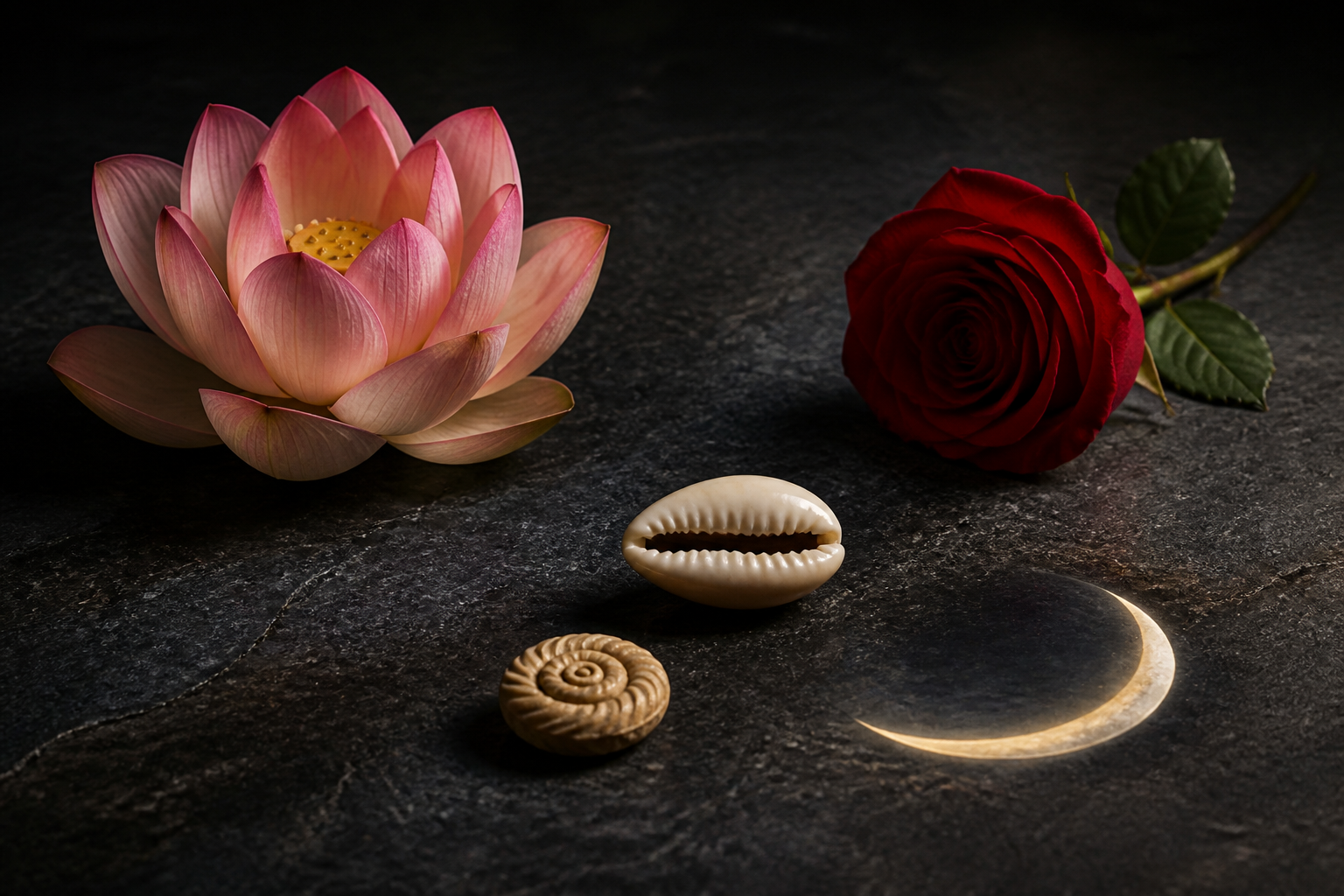
Divine feminine symbols represent qualities associated with creation, fertility, receptivity, transformation, protection, beauty, and embodied wisdom. Familiar examples include the yoni, downward-pointing triangle, moon, lotus, rose, cowrie shell, spiral, serpent, and Venus symbol.
However, these images do not come from a single spiritual tradition. “The divine feminine” is largely a modern umbrella phrase placed over symbols from many cultures, religions, and historical periods. Their meanings can overlap, but they are not interchangeable.
Quick answer: Divine feminine symbols often evoke birth, renewal, intuition, sexuality, nature, and sacred power. Their true meaning depends on cultural context, not appearance alone.
What Does “Divine Feminine” Actually Mean?
The divine feminine is best understood as an archetypal idea rather than a biological category. It describes qualities that many people associate with feminine power, such as nurturing, sensuality, emotional intelligence, creativity, and the ability to receive or transform.
These qualities are not limited to women. Anyone can express tenderness, intuition, fierce protection, patience, or creative force.
I also think it is important not to treat femininity as permanently gentle. Goddesses and female spirits across the world have represented war, death, justice, wilderness, sovereignty, and destruction as well as motherhood and beauty. A symbol of the feminine may hold a blade as readily as a flower.
The Yoni and Vulva
The yoni is among the clearest sacred feminine symbols. In Hindu traditions, it represents generative power and is associated with Shakti, the dynamic energy through which creation becomes possible. It commonly appears with the linga, representing the interdependence of complementary cosmic principles.
Although the yoni can be translated in anatomical terms, reducing it to a sexual symbol misses its religious depth. It may signify source, sacred space, birth, and the creative foundation of existence.
Vulva-shaped imagery also appears outside Hindu culture, but similar forms should not automatically be called yonis. Medieval European churches and castles, for example, sometimes feature stone figures known as Sheela-na-gigs displaying exaggerated vulvas. Their exact purpose remains debated. Proposed meanings include protection, warning, fertility, and confrontation with mortality.
Visual resemblance does not prove a shared origin.
The Downward-Pointing Triangle
A triangle with its point facing downward is frequently used today to represent the womb, vulva, water, receptivity, or feminine energy.
Its meaning comes from several streams of symbolism. In Western alchemy, a downward triangle signifies water. In some tantric diagrams, downward-facing triangles can represent Shakti and the generative feminine principle. The shape may also be read visually as a stylized pubic triangle or opening.
Context matters here. A triangle on a contemporary altar may be a personal symbol of embodiment. The same shape within a traditional yantra belongs to a specific sacred system and should be approached as more than decorative geometry.
The Venus Symbol
The familiar Venus symbol is a circle placed above a small cross. It functions as the astronomical and astrological sign for Venus and was also connected with copper in alchemical traditions. It later became widely used as a symbol for the female sex and women.
Modern interpretations sometimes describe it as a hand mirror belonging to the Roman goddess Venus. That explanation is evocative, but the sign’s exact historical development is more complicated than a single origin story.
Today, the symbol may represent femininity, women, attraction, beauty, or the planet Venus. In astrology, Venus concerns pleasure, values, affection, aesthetics, and relating. It does not simply stand for “female energy.”
The Moon and Water
The moon is one of the most popular divine feminine symbols because its visible cycle suggests change, return, gestation, and renewal. Its relationship with tides also strengthens its association with water, emotion, and bodily rhythms.
Numerous goddesses have lunar associations, including Selene and Artemis in Greek tradition. Yet the moon is not universally feminine. Mesopotamian Nanna-Sin and the Japanese Tsukuyomi are male lunar deities, among other examples.
This is a useful reminder that symbolic gender is culturally shaped. A crescent may feel feminine within your personal practice, but it is not evidence that every society understood the moon in the same way.
Water carries similar layers. It can suggest the womb, cleansing, fertility, surrender, danger, or the hidden depths of feeling. A bowl of water beside a bed might be a private reminder to soften and listen. A sacred river, however, belongs to a living landscape and religious community, not merely to an aesthetic mood.
The Lotus and Rose
The lotus rises from muddy water and opens above the surface. This natural pattern has made it a powerful emblem of emergence, purity, beauty, and spiritual awakening.
Lotus imagery has deep roots in ancient Egyptian religion and in Hindu, Buddhist, and Jain traditions. Its exact significance varies. In Hindu iconography, deities including Lakshmi and Saraswati may be shown with a lotus. Lakshmi’s lotus is commonly connected with beauty, prosperity, abundance, and spiritual purity.
The rose has a different history. It became associated with love and beauty around the Mediterranean, including stories of Aphrodite and Venus. In Christian symbolism, the rose could signify the Virgin Mary, sacred love, purity, or suffering, depending on its color and context.
Both flowers now appear in modern feminine spirituality, but they carry distinct cultural lineages. Choosing one because its particular story speaks to you is more meaningful than treating all flowers as generic goddess symbols.
The Cowrie Shell
With its smooth surface and narrow opening, the cowrie shell has often been interpreted as resembling a vulva. In parts of Africa and across later diasporic traditions, cowries have carried associations with fertility, femininity, wealth, divination, and spiritual protection.
Cowries were also used as currency and markers of status across extensive trade networks. Their story is therefore economic and political as well as spiritual.
A cowrie can symbolize abundance or bodily sovereignty in personal practice. If you are drawing from a named African or African diasporic religion, learn how that community understands and uses it rather than assigning it a universal meaning.
The Serpent and Spiral
The serpent is frequently placed beside divine feminine imagery because snakes shed their skin. This makes them natural symbols of renewal, healing, sexuality, life force, and transformation.
Yet serpent symbolism is deeply ambiguous. Snakes can represent protection, medicine, danger, temptation, royal power, or cosmic order. They may accompany female or male deities. Calling the serpent inherently feminine erases much of that complexity.
The spiral is similarly open-ended. Spirals appear in ancient art across many regions, but their original meanings cannot always be recovered. Modern spiritual interpretations connect them with cycles, birth, inward journeys, and unfolding consciousness. Those meanings may be personally valuable, but a prehistoric spiral is not automatically proof of goddess worship.

Ancient Female Figures and the “Goddess” Label
Small prehistoric figures with pronounced breasts, stomachs, hips, or vulvas are often presented online as universal mother-goddess statues. The figure popularly called the Venus of Willendorf is a famous example.
Such figures may relate to fertility, sexuality, ancestry, self-representation, status, protection, or something no longer recoverable. Without written explanations or decisive context, we cannot know that every female figure portrayed a goddess.
The modern name “Venus” was applied long after these objects were created. It does not mean their makers worshipped the Roman goddess or shared modern ideas about the divine feminine.
Mystery can be meaningful without being filled by certainty.
How to Use Divine Feminine Symbols Respectfully
Begin by asking where a symbol comes from. Is it a personal image, an archaeological motif, or part of a living religion? A rose on your desk requires a different level of cultural care than copying a ceremonial diagram whose purpose you have not studied.
Next, choose a precise meaning. Instead of saying a shell represents “feminine energy,” decide what you want it to recall: bodily autonomy, protection, abundance, or the courage to receive help.
You can then place the symbol somewhere connected to that intention. A spiral inside a journal might mark a period of gradual change. A bowl of water near your workspace could remind you to pause before reacting. A rose pressed between pages might honor a form of love that has matured rather than vanished.
Finally, let the symbol prompt action. If the lotus represents emergence, take one practical step out of a difficult situation. If the moon represents cycles, stop judging yourself for needing rest. If the serpent represents renewal, release an object or habit tied to an identity you have outgrown.
Divine feminine symbols are most powerful when they help you name something real. They can hold mystery without becoming historical proof, and they can inspire devotion without flattening the cultures that gave them life.