
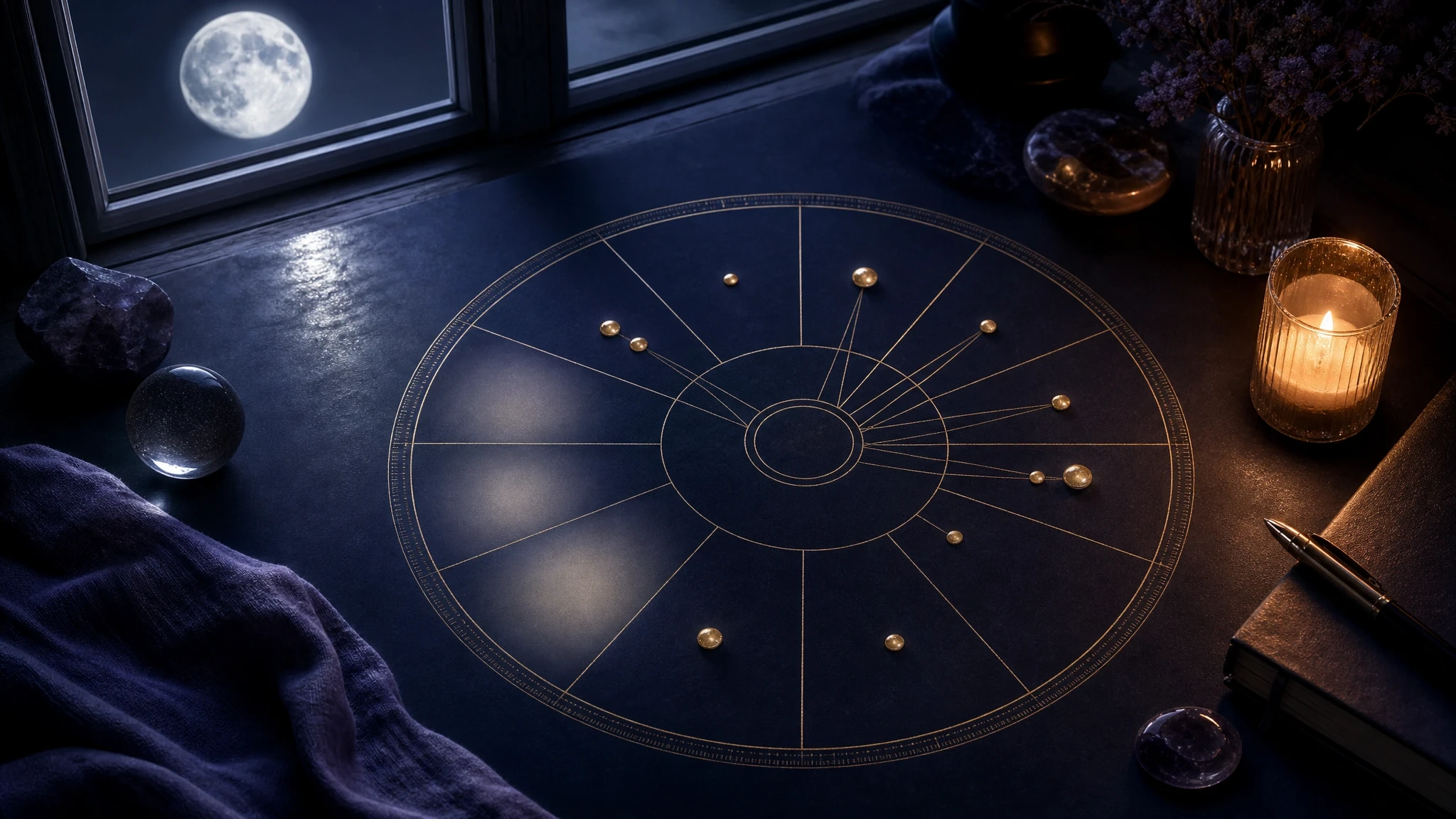
You open your birth chart, notice that the seventh house is empty, and immediately think, Does this mean I’ll never have a lasting relationship? No. Empty houses in astrology do not erase relationships, money, creativity, family, career, or any other part of life.
An empty house simply contains no natal planets under the chart system you’re using. The house still has a sign, a ruling planet, connections to the rest of your chart, and future transits that bring its subjects into focus.
Quick answer: A house represents an area of life, while a planet represents a drive or function operating within it. If a house is empty, interpret its cusp sign, locate that sign’s ruling planet, study the ruler’s placement and aspects, and watch for planets transiting the house.
What Empty Houses in Astrology Actually Mean
Your birth chart has twelve houses, each describing a field of experience. The second concerns resources and values, the fourth concerns home and roots, the seventh concerns partnership, and the tenth concerns vocation and public life.
A planet occupying a house makes that field more concentrated, personal, or demanding. It does not create the field itself.
Someone with an empty fourth house still has a family history, a private life, and a relationship with belonging. Someone with an empty tenth house still makes career decisions and develops a public identity. An empty fifth house does not deny romance, pleasure, creativity, or children.
The chart has not decided that you don’t get that part of life.
With twelve houses and only ten commonly used natal bodies, empty houses are unavoidable when those ten are counted. Usually, several houses are empty because two or more planets gather in the same section of the chart.
An Occupied House Is Not Automatically Better
A common mistake is to treat planets like prizes. A crowded house looks important or fortunate, while a blank one looks deprived. But planetary occupation shows emphasis, not guaranteed ease.
Saturn in the seventh house makes commitment, boundaries, trust, or responsibility a significant developmental subject. Mars in the fourth can bring urgency and friction into home and family matters. Neither placement is automatically bad, but neither is effortless simply because a planet is present.
A planet-filled house has more actors on the stage. An empty house still has a setting, a story, and a director.
In some charts, an empty house operates relatively quietly until its ruler or a transit activates it. Quiet does not mean meaningless, and it certainly does not mean protected from all difficulty.
How to Read an Empty House
I recommend following four steps rather than staring at the blank space.
- Find the sign on the house cusp. A cusp is the boundary or starting point of a house. The sign there describes the style through which you approach that house’s subjects.
- Identify that sign’s ruling planet. Aries is ruled by Mars, Taurus and Libra by Venus, Gemini and Virgo by Mercury, Cancer by the Moon, Leo by the Sun, Sagittarius by Jupiter, and Capricorn by Saturn. Traditional astrology gives Scorpio to Mars, Aquarius to Saturn, and Pisces to Jupiter. Many modern astrologers also consult Pluto, Uranus, and Neptune respectively.
- Locate the ruler in your chart. Its sign and house show where and how the empty house’s concerns are carried.
- Notice the ruler’s major aspects. Conjunctions, squares, oppositions, trines, and sextiles add support, tension, or complexity to the story.
Suppose Cancer begins your empty tenth house. Cancer is ruled by the Moon. If your Moon is in the third house, themes of career and visibility become connected with communication, learning, siblings, local community, or expressing your perceptions.
That does not guarantee a writing career. It shows where the tenth house sends you for more information.
The house looks empty only when you stop following the thread too soon.
Aspects deepen the interpretation. An empty seventh house ruled by Venus square Saturn tells me that partnership is not absent. Instead, commitment could be approached cautiously, with trust treated as something that must be earned. The relevant symbolism appears through Venus, even though Venus is not physically inside the seventh house.
Transits Can Activate an Empty House
Your natal chart is fixed to your birth moment, but the planets continue moving. When a transiting planet enters an empty house or forms a strong aspect to its ruler, astrologers interpret that house’s themes as temporarily more noticeable.
A Saturn transit through an empty fourth house could correspond with sustained attention to home, family duties, boundaries, or the structure of private life. Venus moving through an empty fifth might briefly highlight dating, pleasure, art, or recreation.
Suddenly, the “quiet” house doesn’t feel quiet at all.
These transits describe symbolic periods of emphasis, not guaranteed events. An empty seventh house does not promise lifelong solitude, just as a Venus transit through it does not guarantee marriage.
Check Your Birth Time and Chart Settings
House cusps depend heavily on birth time. If your recorded time is approximate or unknown, treat detailed house interpretations carefully.
Different house systems, including Placidus, Whole Sign, and Equal House, can also place a planet in different houses, especially near a cusp. Nodes, Chiron, asteroids, and calculated points may appear in a house that has no planets. These factors add interpretive layers, but astrologers do not universally count them when deciding whether a house is “empty.”
The most useful question is not, Why is this part of my life missing? Ask instead: Which planet carries this house’s story, where is that planet placed, and what activates it?
Blank space in a birth chart is not absence. It is an invitation to read the chart as a connected whole.