
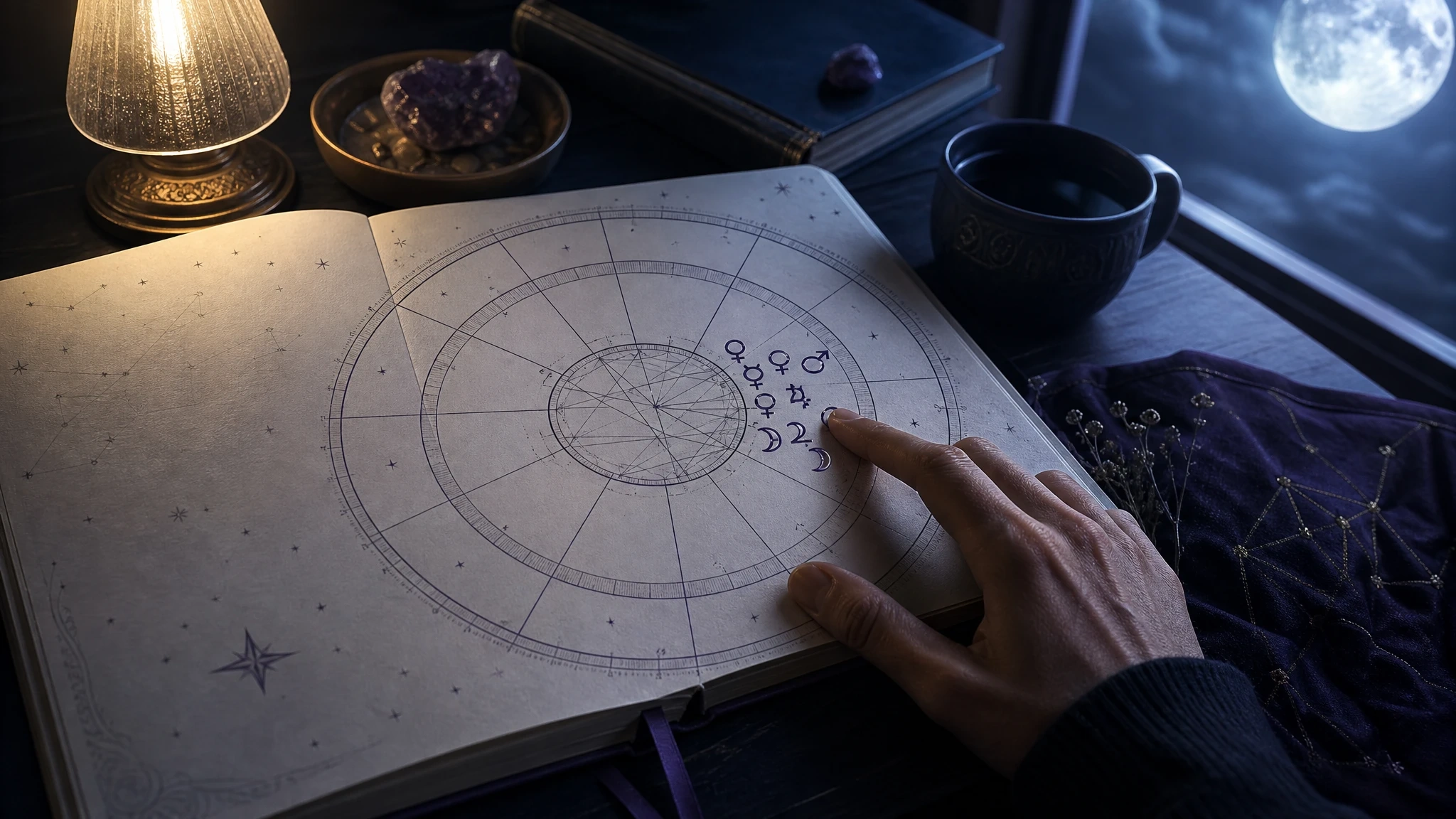
You open your birth chart and immediately notice that one wedge is packed with symbols while the rest looks strangely spacious. Is this crowded section the part that explains everything? The stellium meaning in astrology is simpler and more nuanced: several planetary functions have been bundled into the same sign, house, or both. That area becomes loud, but it does not become your entire personality.
Quick answer
- Planets show which parts of you are bundled together.
- The sign shows the shared style or strategy they use.
- The house shows the area of life receiving concentrated attention.
- Together, they create emphasis, repetition, and sometimes internal congestion.
Stellium Meaning in Astrology: Three Planets or Four?
A stellium is a concentration of several planets in one zodiac sign or astrological house. Three planets is the most common threshold in modern beginner astrology, but there is no universally enforced rule.
Some astrologers require four planets. Others treat three as significant but hesitate to call the common Sun-Mercury-Venus grouping a major stellium unless another planet joins it or the three sit very close together. The Sun and Moon are counted as planets in ordinary astrological shorthand, even though astronomy classifies them differently.
I use the practical distinction: three planets create a noticeable concentration; four or more make that concentration difficult to miss. The interpretation matters more than winning the counting argument.
Nodes, angles such as the Ascendant, Chiron, and asteroids can reinforce a crowded area, but many astrologers do not count them as planets capable of creating a stellium by themselves.
Start With the Planets, Not the Sign
A stellium is not one giant placement. Each planet keeps its own symbolic role:
- Sun: identity, purpose, and conscious direction
- Moon: emotional needs, instincts, memory, and comfort
- Mercury: thought, language, and interpretation
- Venus: attraction, values, pleasure, and relating
- Mars: action, anger, desire, and assertion
- Jupiter and Saturn: expansion and restraint, confidence and responsibility
- Outer planets: slower collective themes that become more personal when closely connected to personal planets or chart angles
If your Sun, Mercury, Venus, and Mars form a stellium, your identity, thinking, relationships, and actions all have to negotiate with one another through a shared channel.
Different needs keep arriving at the same internal door.
The Moon’s participation is especially revealing. If your Moon belongs to the stellium, the concentration reaches into your private emotional life and sense of safety. If your Moon sits elsewhere, the stellium can describe where you are highly active without describing what restores you.
A Sign Stellium and House Stellium Mean Different Things
A sign stellium concentrates style. The sign describes how several planets attempt to do their jobs.
With the Sun, Mercury, Venus, and Mars in Capricorn, for example, identity, communication, love, and action all speak Capricorn’s language. You approach conversation through planning, affection through commitment, and desire through deliberate effort. That does not make every part of you Capricorn. It means several important functions repeatedly rely on structure, competence, restraint, and long-term results.
A house stellium concentrates life attention. Houses are the chart’s areas of experience, such as relationships, home, work, money, creativity, or public life.
A sixth-house stellium keeps drawing several planetary concerns toward routines, work, usefulness, maintenance, and daily well-being. One planet seeks recognition there, another wants harmony, and another brings urgency. The house tells you where life repeatedly gets busy.
Why does everything seem to come back to this one part of my life?
Signs and houses do not line up perfectly. A Capricorn stellium could cross the second and third houses, sharing one style while dividing its attention between resources and communication. A sixth-house stellium could contain planets in two signs, giving them one life arena but different ways of handling it.
House placements also depend on an accurate birth time. If your birth time is uncertain, you can usually trust a sign stellium more confidently than a house stellium. Different house systems can also move planets near house cusps into neighboring houses.
A Stellium Creates Fluency and Congestion
Repeated attention builds fluency. You develop experience, vocabulary, and strong reflexes around the stellium’s sign or house because so much of your chart keeps returning there.
But concentration also creates a traffic jam.
A relationship-house stellium might send your needs for love, freedom, recognition, certainty, and control into the same partnership. A career-house stellium can make achievement deeply satisfying while tempting you to measure every season of life by productivity or public progress.
The problem is not that you are “too intense.” It is that several different problems are being sent to the same internal department.
Does a Stellium Dominate Your Whole Chart?
A stellium is loud, not absolute.
Your Moon can describe emotional needs the stellium does not satisfy. Your Ascendant shapes how you enter situations, while its ruling planet shows how you navigate life overall. Aspects between planets, elemental balance, angular placements, and the condition of the stellium’s planets can strengthen, redirect, or complicate the concentration.
A loose same-sign stellium is also different from a tight conjunction. A conjunction is a close degree-based relationship between planets. If every planet in the stellium sits close together, their needs feel fused and immediate. If they are widely separated within one sign, they still share a strategy, but they do not operate as one inseparable unit.
For a deeper interpretation, find the planet ruling the stellium’s sign. A Capricorn stellium answers to Saturn, for example. Saturn’s sign and house show where that concentrated Capricorn strategy finds direction, pressure, and an eventual outlet.
How to Read Your Stellium Clearly
Return to your chart and ask three questions:
- Which planets are involved? Name the drives that have been bundled together.
- What sign do they share? Identify the strategy those planets repeatedly use.
- Which house receives their attention? Notice the life area where the pattern keeps becoming consequential.
Then ask what happens when that familiar strategy is not enough. Your stellium deserves attention, but it is not a dictator sitting at the center of your chart. It is the place where several parts of you have learned to speak at once.