
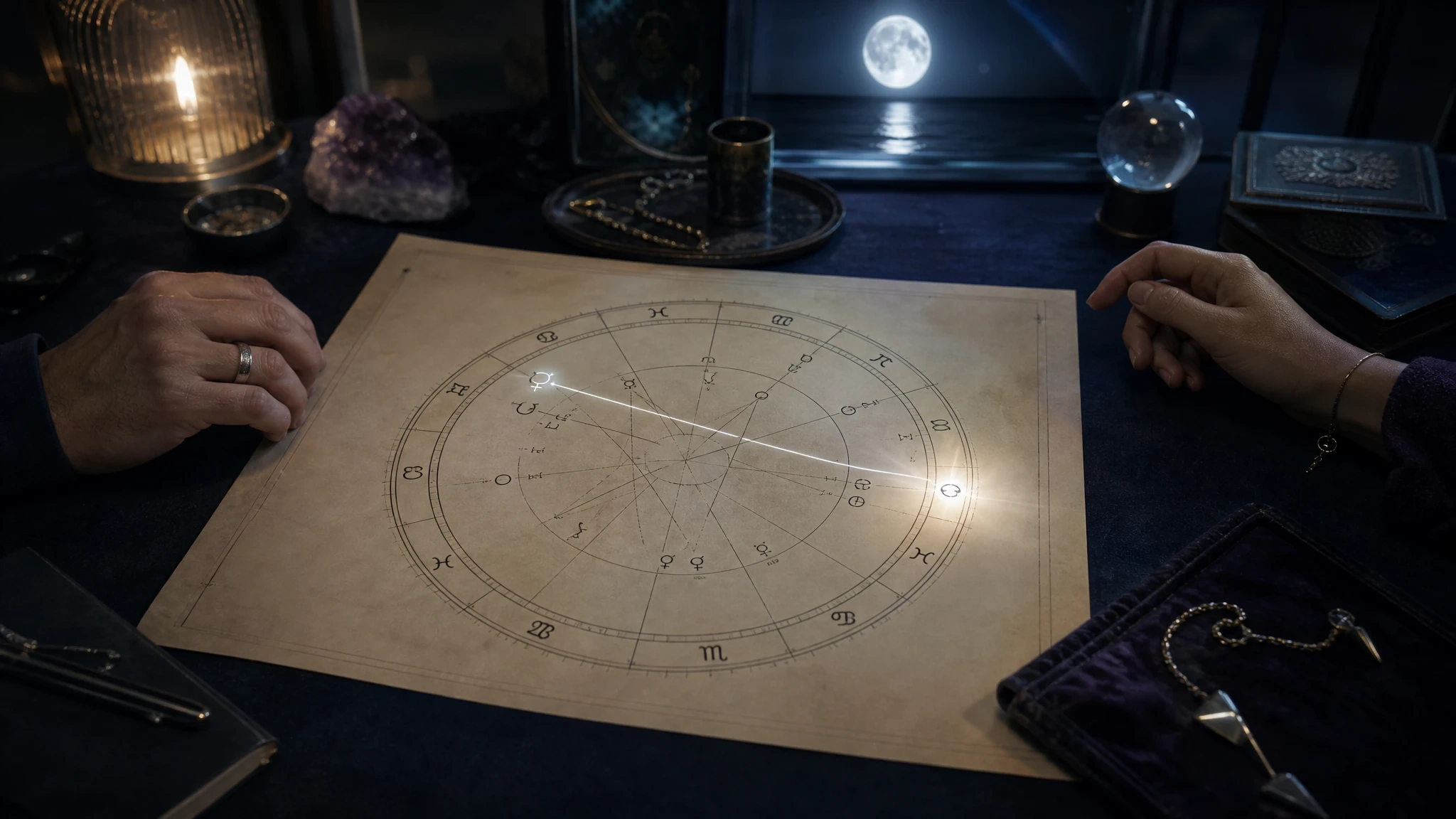
A relationship begins with attraction, but soon the real story is about combining finances, changing homes, managing routines, or making career decisions. Why does commitment keep pulling this particular part of your life into focus? The core 7th house ruler meaning is simple: its house placement shows where close partnership repeatedly becomes consequential.
In Western natal astrology, the seventh house describes committed one-to-one agreements, including marriage and long-term partnership. Its ruling planet carries those subjects into another area of your chart.
Quick answer: The Descendant sign describes your relationship style. Its ruling planet carries that style, and the house containing the planet shows where partnership, negotiation, and commitment most visibly affect your life.
How to Find Your 7th House Ruler
Start with a birth chart calculated from an accurate birth time, then follow three steps:
- Find your Descendant sign. The Descendant is directly opposite your Ascendant, on the western side of the chart. In many chart systems, it marks the seventh-house cusp and is sometimes labeled DC. In whole-sign houses, the Descendant degree sits somewhere inside the seventh sign, while that whole sign functions as the seventh house.
- Identify that sign’s ruling planet. I recommend using traditional rulership first because it gives you one clear planet to follow.
Traditional ruler lookup: Aries and Scorpio are ruled by Mars; Taurus and Libra by Venus; Gemini and Virgo by Mercury; Cancer by the Moon; Leo by the Sun; Sagittarius and Pisces by Jupiter; Capricorn and Aquarius by Saturn.
Modern astrologers also associate Scorpio with Pluto, Aquarius with Uranus, and Pisces with Neptune. You can read these as secondary co-rulers after interpreting the traditional ruler.
- Locate the ruling planet’s house. If you have a Libra Descendant, for example, find Venus. If Venus is in your tenth house, your seventh-house ruler is in the tenth.
Descendant sign equals relationship style. Ruling planet equals the messenger. The planet’s house equals the life arena receiving the message.
Birth-time accuracy matters because the Ascendant and Descendant change throughout the day. House systems can also shift a planet’s house, especially near a cusp, so use one system consistently rather than switching until you find an interpretation you prefer.
The Ruler Is Not the Same as a Planet in the Seventh House
A planet physically inside the seventh house acts directly within relationships. Saturn there, for instance, emphasizes responsibility, boundaries, time, and commitment in one-to-one bonds.
The ruler works differently. It takes seventh-house matters to whichever house it occupies. If Saturn rules your Capricorn Descendant but sits in the fourth house, partnership becomes closely connected with home, family, privacy, and emotional foundations.
An empty seventh house does not mean an empty relationship life.
Every seventh house has a sign and therefore a ruler. If the ruler itself sits in the seventh, partnership becomes a strongly self-reinforcing theme. Remember, too, that the fifth house speaks more directly to dating, pleasure, and courtship, while the seventh concerns established agreements. Traditionally, it also covers contracts and open adversaries.
The 7th House Ruler Meaning by House
I read these placements as areas of emphasis, not guaranteed meeting places or fixed outcomes.
- First house: Partnership shapes your identity, confidence, appearance, and direction. Close relationships teach self-knowledge, but autonomy must remain intact.
- Second house: Relationships bring money, values, possessions, security, and self-worth forward. Compatibility becomes visible through priorities and spending decisions.
- Third house: Communication, learning, siblings, and local life carry the story. Ordinary conversations matter more than impressive romantic declarations.
- Fourth house: Partnership becomes tied to home, family, privacy, ancestry, and emotional roots. Living arrangements or family patterns become defining.
- Fifth house: Romance, creativity, pleasure, children, and self-expression feed partnership. The work is turning desire into a sustainable agreement.
- Sixth house: Routines, work, service, health habits, and responsibilities test the bond. Love becomes visible in what gets done repeatedly.
- Seventh house: Commitment itself is emphasized. Mirroring, negotiation, equality, and responsiveness to another person become central life lessons.
- Eighth house: Shared money, trust, intimacy, vulnerability, loss, and entanglement demand attention. Clear consent and boundaries are essential.
- Ninth house: Relationships expand or challenge your beliefs through study, travel, spirituality, distance, or cultural difference.
- Tenth house: Partnership intersects with career, reputation, ambition, responsibility, or public life. Relationships influence visible decisions and long-term goals.
- Eleventh house: Friendship, communities, causes, and future plans support partnership. The bond needs to belong within a larger vision.
- Twelfth house: Relationships touch privacy, retreat, sacrifice, unconscious patterns, or feelings that resist language. This placement requires clarity, not predictions of secrecy or doom.
Read the Pattern, Not a Prediction
A ninth-house ruler does not guarantee that you’ll meet a spouse abroad. You could meet someone nearby and find that the relationship completely changes your worldview. Likewise, a tenth-house ruler connects partnership with career and public responsibility without promising a workplace romance.
The planet’s sign, aspects, retrograde status, and overall condition add the next layer. Planets inside the seventh remain important, too. Neither the ruler nor its occupants should be interpreted in isolation from the wider chart.
Most importantly, this placement describes your symbolic relationship pattern. It cannot expose another person’s private intentions or determine whether a relationship will succeed.
What part of life becomes impossible to ignore once a relationship grows serious? That recurring arena is where your seventh-house ruler is already speaking.