
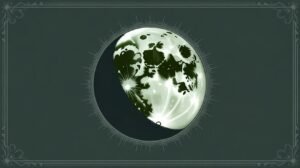
Everyone loves the full moon. Everyone has opinions about the new moon. And the waxing gibbous? It gets a polite nod on the way past, like a middle child at a family dinner.
That’s a real shame, because this phase is where most people’s spiritual practice quietly falls apart.
I’ve been tracking lunar cycles for over twenty years. Charting them against my own life, my clients’ lives, the rhythms I can feel in my body before I even check the calendar. And the pattern is always the same. Someone sets gorgeous new moon intentions. They ride the waxing crescent energy with real fire. The first quarter sharpens their resolve. Then the waxing gibbous arrives, and they go quiet. Frustrated. Second-guessing everything. Two weeks of momentum dissolving into “maybe this isn’t working.”
The waxing gibbous moon spiritual meaning is, at its core, about learning to stay when everything in you wants to either push harder or walk away. It is the phase of almost. And almost is one of the most spiritually demanding places a person can stand.
What Is the Waxing Gibbous Moon?
The waxing gibbous is the lunar phase between the first quarter (half moon) and the full moon. Roughly 51% to 99% of the moon’s visible surface is illuminated, and that percentage grows each night. The phase lasts about five to six days.
The word “gibbous” comes from the Latin gibbosus, meaning humpbacked or swollen. It describes that distinctive shape you’ll recognize if you spend any time looking up: more than a half circle, less than a full one. A swollen disc of light that looks so close to full you might mistake it on a casual evening glance.
That visual is the whole metaphor. So close. Not quite there.
On a typical night during this phase, you’re seeing around 75% illumination. The light is strong enough that the moon casts visible shadows across your garden, your windowsill, your hands. You can read by it. She rises in the afternoon and stays visible well into the night. Of all eight phases, the waxing gibbous is one of the most present in our sky, yet she gets the least spiritual attention.
I think that’s because her medicine is uncomfortable. And people tend to skip the uncomfortable phases.
The Core Spiritual Meaning of the Waxing Gibbous Moon
Here’s what most articles will tell you: the waxing gibbous is a time of refinement. Adjust your plans. Stay patient. Trust the process.
All of that is true. None of it is the full picture.
The waxing gibbous moon spiritual meaning lives in a specific tension. You have done the work. You set intentions at the new moon, you took action during the waxing crescent and first quarter, and now you are suspended between effort and result. The seeds are planted. The soil is warm. And nothing visible has broken through yet.
This is the phase of refinement, yes. You are polishing, editing, adjusting. The astrologer Dane Rudhyar, whose 1967 book The Lunation Cycle remains the most important text on lunar phases in Western astrology, called this the “Overcoming” phase. The crisis of the first quarter has passed. The struggle to get started is behind you. What remains is the quieter, harder work of integration. Taking what you’ve built so far and making it actually good.
Rudhyar understood something that Instagram astrology tends to miss entirely. The energy here is not exciting. It is not the rush of a new beginning or the drama of a full moon culmination. It is the sustained, focused, sometimes unglamorous work of bringing something to completion. Think of a sculptor who has shaped the rough form and is now working the fine details with steady hands. Or a novelist deep in revision, cutting the sentences she loved that don’t serve the story.
There is a concept I return to often in my own practice that captures this beautifully: spiritual polishing. The idea that our souls are like rough stones, and the waxing gibbous is when the careful, repetitive, patient work of polishing actually happens. One small adjustment at a time. One conscious choice at a time. No dramatic transformation. A gradual revealing of what was always underneath.
Historically, across multiple cultures, the waxing gibbous symbolized the final steps. The last stretch before completion. Which sounds encouraging until you’ve lived through it a few dozen times and realized the final stretch is almost always where people quit.
The Shadow Side Nobody Talks About
I need to be honest with you here, because the spiritual wellness internet will not be.
The waxing gibbous moon is hard. For many people, it is the most difficult phase of the entire lunar cycle. And if nobody has told you that before, I’m telling you now so you stop blaming yourself when the gibbous moon rolls around and you feel like everything is falling sideways.
Here is what actually happens during this phase, in my experience and in the experience of hundreds of clients I’ve walked through lunar cycles with:
Perfectionism shows up wearing a spiritual costume. The drive to refine and adjust is real and healthy. The problem is that it tips into obsessive tweaking, endless revising, a refusal to let anything be good enough. “I’m just refining my intentions” starts sounding a lot like “I’m terrified of what happens when this actually works.”
Self-sabotage gets creative. I have watched clients, and I have watched myself, unconsciously dismantle progress right before the full moon. Picking fights. Missing deadlines. Suddenly deciding the whole plan was wrong from the beginning. If your manifestation is about to come through and some part of you doesn’t believe you deserve it, the waxing gibbous is when that part makes its move.
The frustration is bone-deep. You’ve been working at this for two weeks. You’re tired. Results feel close yet intangible. The temptation to either force the outcome through sheer willpower or abandon the whole thing is enormous. Neither serves you.
Burnout lives here. The waxing gibbous asks for stamina, and if you’ve been overextending since the new moon, this is when your body sends the invoice. Exhaustion, irritability, restless sleep, vivid or unsettling dreams. Some people report difficulty falling asleep during this phase, likely related to the increasing ambient light she casts through their windows.
The spiritual meaning of the waxing gibbous includes all of this. The discomfort is part of the teaching. If you can sit with the tension of almost, if you can hold your nerve when everything feels unfinished and imperfect, you develop something that no amount of crystal grids or intention-setting rituals can give you: the ability to trust a process that hasn’t proven itself yet.
That is genuine spiritual maturity. And the gibbous moon hands it to anyone willing to stay.
Also read: Astrology Phases of the Moon
The Waxing Gibbous in Myth and Tradition
In the Roman and Greek traditions, the waxing gibbous was the phase of Diana and Artemis. This matters. Diana was the goddess of the hunt, the wilderness, and the moon herself. Fiercely independent. Relentlessly focused. Famous for never abandoning a pursuit once she’d committed to it. If you’ve seen classical depictions of her running through a moonlit forest with her bow drawn, you’ve felt this energy in your chest before you could name it.
That is the waxing gibbous. You stay on the trail. You don’t turn back. You don’t look for shortcuts. You trust that what you’re tracking is ahead of you in the dark woods, and you keep walking.
Diana also protected the vulnerable and guarded her boundaries fiercely. There’s a teaching in that for gibbous moon energy. As you approach the intensity of the full moon, knowing what to protect and what lines to hold becomes essential.
In the Triple Goddess framework, the waxing gibbous sits at a threshold I find endlessly fascinating: the space between Maiden and Mother. The Maiden’s spark has matured into something with weight and responsibility. The Mother’s generative power is nearly here, almost ready. The waxing gibbous is the becoming. Still in transit. No longer what she was, not yet what she will be.
In Hindu astrology, the waxing phase of the moon is called Shukla Paksha, the bright fortnight, and it is considered broadly auspicious. The waxing gibbous specifically is seen as a powerful time for beginning new ventures and bringing projects to their peak. The energy is considered sattvic: pure, harmonious, conducive to right action.
The biblical tradition uses the moon as a marker of divine timing. Psalm 104:19: “He made the moon to mark the seasons.” The waxing gibbous, in this framework, represents the season of preparation before blessing. The period when abundance is being assembled behind the scenes, even if you can’t see the full picture yet.
And among various indigenous and folk traditions, the waxing gibbous was recognized as a time of preparation before harvest. The crops are nearly ripe. The gathering is imminent. You prepare your baskets. You make room to receive.
The Waxing Gibbous Moon in Astrology
Beyond Rudhyar’s Overcoming phase, the waxing gibbous carries specific astrological weight that’s worth understanding if you work with planetary cycles at all.
During this phase, the moon is between 135 and 180 degrees ahead of the sun. The aspect formed moves from a sesquiquadrate (135°) toward the opposition that defines the full moon. The sesquiquadrate is a minor hard aspect associated with agitation and the need for adjustment. It carries friction. Things rub. You feel the pressure to change course slightly, to fine-tune what you’ve been building.
This is why the waxing gibbous period often feels restless in the body. There’s a low-grade astrological tension that won’t resolve until the full moon’s opposition brings everything into the open.
The zodiac sign the moon occupies during its gibbous phase colors the experience considerably. A waxing gibbous in Virgo intensifies the perfectionism and analytical energy to an almost suffocating degree. In Sagittarius, the restlessness turns philosophical and you might find yourself questioning the meaning of your goals entirely. In Scorpio, the shadow material I described above surfaces fast and raw. In Pisces, the emotional sensitivity is extraordinary.
If you use a lunar calendar or app, start paying attention to the sign the moon is in during the gibbous phase each month. After three or four cycles of tracking this, you’ll begin to feel the patterns in your own life before you even check.
Born Under a Waxing Gibbous Moon
If you were born during the waxing gibbous phase, you carry this energy in your bones. You have always carried it.
You are, in all likelihood, someone other people describe as a perfectionist. You prefer the word “thorough.” You have high standards and a natural, almost uncanny ability to see what’s slightly off in any situation and know exactly how to fix it. Where others see a finished product, you see fifteen things that could be improved. This is a genuine gift. It is also, at times, genuinely exhausting.
People born under the waxing gibbous tend to be the builders and the refiners. You’re rarely the person who comes up with the wild idea out of thin air. You’re the one who takes someone’s wild idea and makes it real, functional, and beautiful. You see potential in rough things. In a team, you are invaluable. On your own, you can spiral into overthinking so deep it feels like quicksand.
There’s a nurturing quality that runs through waxing gibbous births like an underground river. I’ve seen it consistently for two decades. People feel safe around you. They come to you for guidance without you inviting it. You listen well. You notice what others miss. The astrologer Demetra George observed that waxing gibbous people often experience a series of intense, brief, almost karmic relationships that serve a purpose and then dissolve. I’ve seen this play out so many times I’ve stopped being surprised by it.
Your shadow? You already know. The feeling that nothing is ever quite done. The sense of perpetual almost. You may feel, particularly in your twenties, like you’re always preparing for a life that hasn’t fully started yet. Several astrologers I trust have noted that waxing gibbous people come into their own in their thirties and beyond. The maturity that felt isolating in youth becomes magnetic as you age. Like fine wine, except that analogy doesn’t capture how much the waiting hurt.
The deepest teaching for waxing gibbous births: completion doesn’t require perfection. Let things be finished. Let them be imperfect and breathing, rather than endlessly refined and never released into the world.
Waxing Gibbous Moon and Love
In existing relationships, the waxing gibbous phase is a time of deepening and honest assessment. The romantic fireworks of new connection (new moon energy) have settled. The first quarter’s challenges and power struggles have been navigated. Now comes the real question: is this actually working? And what needs to shift so it can work better?
This is a powerful window for couples to have the conversations they’ve been circling around. The gibbous energy supports honesty, adjustment, and the kind of love that isn’t afraid to look at itself clearly. It does not support pretending everything is fine when it isn’t.
For singles, this phase sharpens your clarity about what you actually want in a partner. If you set a new moon intention around love, the gibbous phase is when you refine your understanding of that intention. Maybe you thought you wanted excitement and you’re realizing you want steadiness. Maybe you asked for partnership and you’re recognizing that you need to work on your relationship with yourself first. The gibbous moon doesn’t hand you answers. She gives you better questions.
If you were born under a waxing gibbous and you’re trying to understand your love style: you are loyal, attentive, and deeply invested in making relationships work. You will notice every small thing your partner does. Every kindness and every slight. You need someone who appreciates your care without feeling suffocated by it, and who can gently remind you that a relationship doesn’t need to be optimized. It needs to be lived in.
Rituals for the Waxing Gibbous Moon
The waxing gibbous doesn’t want elaborate ceremony. She wants precision and sincerity.
The Re-evaluation Ritual. Pull out whatever you wrote at the new moon. Your intentions, your goals, your desires. Read them with fresh eyes. What still feels alive in your body when you read it? What has gone flat? Cross out what no longer applies. Sharpen what remains. This is editing, and editing is its own form of magic.
The Patience Sit. This is my favorite waxing gibbous practice, and I’ve never seen anyone else teach it. Set a timer for twenty minutes. Sit quietly. Don’t meditate in the traditional sense. Just sit with the feeling of almost. Let the tension of unfinished things be present without trying to resolve it. Notice what comes up. Your need to check your phone. Your itch to plan, to fix, to force an outcome. Just notice. The practice is the noticing. After a few months of doing this, something shifts in you that’s hard to describe. You become someone who can hold open space without rushing to fill it. That capacity will change every area of your life.
Refinement Journaling. Unlike new moon journaling, which is expansive and visionary, gibbous moon journaling is editorial. Write through these questions slowly, by hand if you can:
Where am I being a perfectionist when good enough would actually serve me better?
What am I afraid will happen if this works?
What would it feel like to trust that what I’ve been building is already on its way to me?
Crystal Work. Clear quartz for clarity and amplification. Amethyst for intuitive refinement and the kind of spiritual insight that comes through the body rather than the mind. Fluorite if your thoughts are scattered and you need to focus. Moonstone to deepen your relationship with the full lunar cycle. Citrine if your confidence has taken a hit and you need to remember what you’re capable of.
Herbal Support. Rosemary tea for mental clarity. Lavender in a warm bath for when the gibbous restlessness settles into your nervous system and won’t let go. Peppermint to stay sharp when you’re flagging. Chamomile for the nights when your mind won’t stop revising and you need, more than anything, to sleep.
How to Actually Work With This Phase
If you take one thing from this article, let it be this.
The waxing gibbous moon is asking you a single question: can you stay?
Can you stay with the discomfort of almost? Can you keep going when the results haven’t materialized yet? Can you refine without obsessing? Can you trust without proof? Can you hold your vision steady when every instinct says to either force it or walk away?
The full moon is coming. She always comes. The light always completes itself.
Your work, during the waxing gibbous, is to let it.