
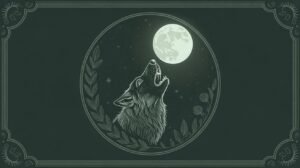
There is a story we have been telling ourselves about the Wolf Moon for a very long time, and most of it is wrong. Not wrong in the way that matters to astronomers or historians, necessarily, but wrong in the way that matters to those of us who work with the moon as a living presence in our spiritual lives. The story goes something like this: wolves howl at the moon because they are hungry, and January’s full moon earned its name because our ancestors heard those desperate cries echoing across frozen landscapes when food was scarce and survival was uncertain. It is a compelling image, and it contains a grain of emotional truth, but the wolves themselves would tell you a different story if you knew how to listen.
Wolves do not howl at the moon. They howl to find each other. They howl to say, I am here, where are you, come home to me. They point their muzzles skyward not because they are serenading some celestial goddess but because that angle carries their voice farther; a single howl can travel ten kilometers across open terrain, a beacon in the darkness for pack members who have become separated during a hunt or a territorial patrol. The moon happens to be there, luminous and watchful, but it is not the point. The point is connection. The point is belonging. The point is that even the wildest creatures among us need to know they are not alone.
This distinction matters because it changes everything about how we might work with January’s Wolf Moon. If the wolf howls from hunger, then the Wolf Moon becomes a moon of lack, of desperation, of white-knuckled survival through scarcity. But if the wolf howls to locate its pack, then the Wolf Moon becomes something else entirely; it becomes a moon of reaching out, of sacred communication, of trusting that your people will answer when you call. January 2026’s Wolf Moon rose on the third of the month in the sign of Cancer, and though its peak illumination has passed, the questions it stirred are still moving through us, still asking to be answered. Who do you howl for? And who howls for you?
The Wolf Moon Across Cultures: More Than One Story
The name Wolf Moon comes to us through both Celtic and Old English traditions, carried across the Atlantic by European settlers who found that the wolves of the new world howled just as persistently as the ones they remembered from home. But January’s full moon has worn many names across many cultures, and each name reveals something about what our ancestors noticed when they turned their faces toward the winter sky.
The Celts also called this the Quiet Moon and the Stay Home Moon, names that speak to the enforced stillness of deep winter, the long nights spent by the fire when travel was dangerous and the world outside the door belonged to other creatures. The Anglo-Saxons knew it as the Moon After Yule, positioning it in relation to their great winter festival and the slow return of the light. The Assiniboine people of the Northern Great Plains called it the Center Moon because it marked the middle of the cold season, a turning point when you could look back at what you had survived and forward to what still lay ahead. The Cree called it the Cold Moon and the Frost Exploding Moon, while the Dakota named it the Severe Moon and the Hard Moon, this last name referring to the crust that forms on fallen snow when temperatures drop low enough. The Ojibwe called it the Spirit Moon. The Arapaho called it When Snow Blows Like Spirits in the Wind.
What strikes me about this collection of names is how they hold both the hardship and the holiness of January without trying to resolve the tension between them. This is a severe moon, a hard moon, a moon of frost exploding and spirits blowing through the snow, and it is also a quiet moon, a spirit moon, a moon for staying home and centering yourself in the middle of the long dark. The wolf moves through all of these meanings, a creature that embodies both the danger and the devotion of winter, both the wildness that threatens and the loyalty that protects.
The Wolves Who Chase the Moon: Norse Mythology and the Hunger That Creates Time
If you want to understand why wolves and moons have been linked in human imagination since the Neolithic age, you could do worse than to spend some time with the Norse. In their cosmology, two great wolves named Sköll and Hati race eternally across the sky, one chasing the sun and one chasing the moon, their pursuit so relentless that it creates the very passage of time. Sköll, whose name means treachery or mockery, hunts the sun goddess Sól as she drives her chariot from horizon to horizon. Hati, whose name means one who hates, pursues her brother Máni, the moon. They are the children of Fenrir, the monstrous wolf who will one day kill Odin himself, and their grandmother was an unnamed giantess who lived in a forest called Ironwood and gave birth to wolf-giants in the darkness between the worlds.
The Norse believed that at Ragnarök, the twilight of the gods, Sköll and Hati would finally catch their prey. The sun and moon would be devoured, the stars would vanish from the sky, and the world would plunge into Fimbulwinter, three years of endless cold with no summer to break the darkness. This is a myth about the end of everything, but it is also a myth about the nature of time itself; the wolves’ eternal chase is what keeps the celestial bodies moving, what separates day from night and season from season. Without the hunger, there would be no motion. Without the pursuit, there would be no change.
There is something here worth sitting with when you work with the Wolf Moon. The Norse wolves embody a kind of cosmic hunger that is both destructive and generative, both the force that will eventually unmake the world and the force that keeps it turning in the meantime. What are you pursuing with that kind of relentless devotion? And what pursues you? The Wolf Moon asks us to look honestly at our hungers, to acknowledge the things we chase across the sky of our own lives, and to recognize that this chasing is not separate from our purpose but somehow essential to it.
The Wolf as Protector: Japanese Traditions and the Escort Through Darkness
In Japan, the relationship between humans and wolves took a very different shape, though it was no less sacred. The Japanese word for wolf, ōkami, sounds nearly identical to the word for great god or great spirit, and this linguistic echo reflects a deep cultural understanding of wolves as divine messengers, protectors of the mountains, and guardians who walked the boundary between the physical and spiritual worlds. Unlike Western folklore, which tends to cast the wolf as predator and threat, Japanese tradition honored the wolf as a creature deserving of reverence and even worship.
One of the most striking Japanese wolf traditions is the belief in the okuri-ōkami, the escort wolf. According to this folklore, wolves would follow solitary travelers walking through mountain passes at night, their presence silent and watchful in the darkness behind. If the traveler made it home safely without stumbling or falling, the wolf was understood to have been a protector, a guardian spirit ensuring safe passage through dangerous terrain. But if the traveler fell, the wolf would pounce. The lesson encoded in this tradition is not about the wolf’s malevolence but about the traveler’s composure; you were supposed to move through the darkness with intention and steadiness, never showing fear, never losing your footing. If you stumbled and wanted to survive, you had to quickly pretend you had sat down on purpose, calling out how tired you were and taking a deliberate rest before continuing on your way. The wolf respected intention. The wolf respected those who did not let fear rule them.
There is an old Japanese saying that captures the proper attitude toward wolves and the territories they claimed: on a wolf mountain, be quiet; on a bear mountain, be loud. Bears can be startled away with noise, but wolves own their mountains. You enter their space with humility and respect, or you do not enter at all. The Japanese wolf has been extinct since 1905, but there are still shrines dedicated to wolf spirits throughout the islands, places where people come to pay respects and ask for protection. The Ainu people of Hokkaido believed their ancestors descended from a white wolf who mated with a goddess, and they worshipped the wolf as Horkew Kamuy, the Howling God.
When I work with the Wolf Moon, I often think about the okuri-ōkami and what it might mean to have a wild, sacred presence following us through the dark passages of our lives. What is escorting you through this winter? What protector-energy moves behind you in the shadows, watching to see whether you will keep your footing or fall? The Wolf Moon is a good time to acknowledge these presences, to turn at your doorway and offer thanks for safe passage, and to ask yourself whether you have been moving through your challenges with the kind of intentional steadiness that earns a guardian’s respect.
The Wolf Within: Werewolves, Shadow, and What the Full Moon Reveals
We cannot talk honestly about wolves and moons without talking about the werewolf, that figure of terror and transformation who has haunted European imagination since antiquity. Most of us know the Hollywood version: the full moon rises, the cursed man transforms against his will, and the beast emerges to hunt through the night until dawn restores his human form. But this is a simplified telling of a much older and stranger tradition, one that has more to teach us about shadow work than most practitioners realize.
In the original folklore, werewolf transformation was not necessarily tied to the lunar cycle at all. People became wolves through divine punishment, magical belts or cloaks made from wolf pelts, curses from witches, consumption of wolf flesh mixed with human meat, or simply through being born the seventh son. The ancient Greeks told of King Lycaon, who was transformed into a wolf by Zeus as punishment for serving the god human flesh at a banquet; his name survives in the word lycanthropy, the clinical term for the delusion of being transformed into an animal. Medieval traditions described werewolves who could shift at will, their transformation a mark of power rather than curse, and some cultures considered the ability to take wolf form a shamanic gift that allowed travel between worlds.
The full moon became the primary trigger for transformation through twentieth-century cinema, particularly the 1941 film The Wolf Man and its sequel. But even before Hollywood standardized this element, there were strands of European folklore that connected werewolves to the full moon, the winter solstice, and the liminal times when the boundary between human and animal grew thin. The moon, with its monthly cycles of waxing and waning, has always been associated with change, with the parts of ourselves that shift and transform beyond our conscious control. The werewolf is what emerges when we can no longer suppress our wildness.
This is shadow territory, and the Wolf Moon invites us into it with both hands. What wolf lives inside you? What part of your nature have you been keeping caged because it feels too hungry, too fierce, too uncontrollable for polite society? The werewolf in folklore was feared because the transformation was involuntary, because the civilized self had no power over what the beast did during the night, because violence and appetite broke free of all restraint. But shadow integration does not work by keeping the wolf locked away forever; it works by building a relationship with the wild self, by learning its language, by understanding what it needs so that it does not have to break down the door to get your attention. The Wolf Moon is a good time to ask what your inner wolf is hungry for and whether you have been feeding it or forcing it to howl from starvation.
The 2026 Wolf Moon in Cancer: Emotions as Initiation
This year’s Wolf Moon rose in Cancer, and that placement matters more than you might think. Cancer is the only zodiac sign ruled by the Moon herself, which means that a full moon in Cancer carries an especially potent emotional charge, a kind of lunar homecoming that amplifies everything the moon naturally represents. Cancer is cardinal water, the sign of initiation through feeling; where Pisces holds emotion with mystical awareness and Scorpio transforms emotion into power, Cancer simply feels, immediately and without filter. The nervous system responds before the rational mind can catch up. The body knows before the intellect understands.
Cancer rules the fourth house of home, family, ancestral roots, and emotional security. It is represented by the crab, a creature that carries its home on its back and protects its soft interior with a hard shell. But crabs cannot grow unless they leave their shells behind; there are vulnerable periods when the old shell has been shed and the new one has not yet hardened, times when the crab must rely on instinct and quick movement to survive. The Wolf Moon in Cancer asks whether you are ready to leave your old shell behind. What protection have you outgrown? What softness are you ready to stop hiding?
The 2026 Wolf Moon was conjunct retrograde Jupiter in Cancer, which means emotions got bigger so we could understand them better. Feelings that seemed manageable may have swelled to uncomfortable proportions; old emotional patterns may have resurfaced with unexpected intensity; intuition may have grown loud enough to finally hear. Jupiter retrograde does not bring new experiences so much as it asks us to revisit and integrate what we have already encountered, and in Cancer, that revisitation happens through the body, through the heart, through the memories stored in our cells and our family lines. If something from your past came up around the Wolf Moon, it came up because it wanted to be completed, not because it wanted to trap you.
The Sun, Venus, and Mars were all in Capricorn opposing this Cancer Moon, creating tension between the private emotional life and the public face we show the world, between what feels good and what looks good, between caring for ourselves and meeting external obligations. This is the core polarity of the Cancer-Capricorn axis: how do we build lives that support our emotional wellbeing rather than deplete it? How do we honor our need for security without sacrificing our ambitions, and pursue our ambitions without abandoning our inner lives? These questions are still worth working with even after the moon has waned. They may be worth working with all year.
Working with the Wolf Moon: Practices for Integration
The peak of the Wolf Moon has passed, but lunar energy does not operate like a light switch. The full moon’s influence extends several days in either direction, and more importantly, what a powerful moon stirs up often needs weeks or months to fully process. The real work of the Wolf Moon is not in the rituals we perform on the night of January third but in the integration we do afterward, the way we carry forward what was illuminated into the ordinary days of our lives. Here are some ways to continue that integration.
Find your howl. The wolf does not howl at the moon; the wolf howls to be found. What in you needs to be sounded, needs to be given voice, needs to reach out across the distance and trust that someone will answer? This does not have to be literal, though you might be surprised how releasing it feels to go somewhere private and actually howl. It can be a conversation you have been avoiding, a truth you have been swallowing, a creative work you have been keeping silent. The Wolf Moon energy supports expression, especially the kind that comes from a place of genuine need rather than performance.
Honor your pack. Wolves survive winter not through isolation but through cooperation and trust within the pack. Who are your people? Who keeps you alive through the cold seasons, literally and metaphorically? The Wolf Moon is a good time to reach out to those people with gratitude, to strengthen the bonds that sustain you, and to ask honestly whether you have been showing up for your pack the way they have been showing up for you. Cancer energy especially supports this work; it reminds us that we are not meant to survive alone, that interdependence is not weakness but the very structure of a well-lived life.
Work with water. Cancer is a water sign, and water holds emotion the way the moon holds light. Salt baths are traditional for releasing what no longer serves; you can add intention by naming what you want to wash away as you step into the water. Crying is a form of water magic, a release of sacred fluid that carries pain out of the body. If you made moon water on the night of the full moon, now is the time to use it: for cleansing your space, for anointing yourself before meditation, for offering to plants or the earth. If you did not make moon water, you can still work with whatever water is available to you. Run a bath, visit a body of water, stand in the shower and imagine the emotional residue of the past weeks flowing down the drain.
Meet your inner wolf. In meditation or journaling, ask to meet the wolf that lives inside you. Ask it what it hungers for. Ask it what it is protecting. Ask it what it needs from you in order to stop howling from starvation and start howling from belonging. Shadow work is not about destroying or suppressing the wild parts of ourselves; it is about bringing them into relationship, learning their language, understanding that they have wisdom to offer even when their methods seem frightening. Your inner wolf is not your enemy. Your inner wolf is the part of you that knows how to survive.
The Wolf Moon’s True Teaching
January is a severe month, a hard month, a month when spirits blow through the snow and the frost explodes in the cold. It is also a quiet month, a spirit month, a month for staying home and tending what matters most. The Wolf Moon holds both of these truths without trying to resolve them, because life itself holds both of these truths, because we are creatures who contain multitudes and seasons and contradictions that do not need to be fixed.
The wolf does not howl at the moon because it is hungry. The wolf howls to find its pack, to say I am here, where are you, come home to me. This is the Wolf Moon’s true teaching, and it is a teaching we need badly in a world that encourages isolation and rewards self-sufficiency above all else. You are not meant to survive winter alone. You are not meant to carry everything in silence. You are allowed to need people, to reach out across the distance, to trust that your howl will be answered by those who love you.
The moon has waned since January third, but the questions she stirred are still alive. Who is your pack? What are you pursuing with relentless devotion? What protector-energy escorts you through the dark passages? What wolf lives inside you, and what does it need? These are not questions that get answered once and filed away. They are questions you live with, questions that deepen over time, questions that the Wolf Moon will ask you again next January and the January after that. For now, it is enough to let them move through you, to notice what they illuminate, and to trust that the howl always finds its way home.
• • •
Nymera writes about lunar cycles, shadow work, and the old ways of knowing at MyMoonMysteries.com.