
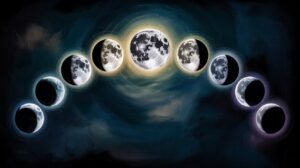
Most people encounter the moon phases in astrology through fragments. A sentence about the Full Moon making emotions intense. A reminder that the New Moon is good for setting intentions. A ritual here, a warning there. Over time, this creates familiarity without understanding.
What tends to be missing is the logic of the lunar cycle. Not logic in the rational sense, but coherence. A sense of how the phases relate to one another, why they unfold in this order, and what they describe about emotional life when observed over time.
The astrology phases of the moon form a complete psychological cycle. Each phase has a specific function, and each one prepares the ground for the next. When the cycle is understood as a whole, the confusion dissolves.
What astrologers mean by “moon phases”
In astrology, the moon represents instinctive emotional response, memory, and the way we orient ourselves toward safety and belonging. Unlike the Sun, which symbolizes conscious identity and direction, the moon reflects processes that operate beneath deliberate choice.
The moon phases describe the changing relationship between the Sun and the Moon as seen from Earth. Symbolically, this relationship mirrors how awareness interacts with feeling over time.
This is why moon phases are not personality traits. They are timing mechanisms. They describe when certain emotional processes tend to surface, mature, peak, and resolve.
The lunar cycle as a psychological arc
The lunar cycle unfolds over approximately twenty-nine days. Within that span, emotional life tends to move through eight recognizable stages.
These stages are not abstract concepts. They show up in relationships, creative projects, conflicts, healing processes, and personal decisions. Once you recognize them, they become difficult to unsee.
Below, each phase is explained not as a slogan, but as a lived psychological state.
New Moon: internal orientation
The New Moon marks the beginning of the cycle, though it rarely feels like a beginning externally.
Emotionally, this phase is characterized by inwardness. Attention turns toward private needs, subtle desires, and quiet realizations that have not yet taken form. Energy is present, but it is diffuse and unexpressed.
This is why New Moons are associated with intention setting. An intention at this stage is not a goal statement. It is a recognition of what wants to grow.
Attempts to force visibility or decisive action during the New Moon often feel strained. The psyche is orienting itself. Clarity is still forming.
Waxing Crescent: tentative movement
As the moon begins to separate from the Sun, internal awareness starts seeking expression.
The Waxing Crescent phase often carries a mixture of hope and uncertainty. The desire to move forward is present, but confidence is not yet stable. Doubt tends to arise not because the direction is wrong, but because it is still new.
Psychologically, this phase supports experimentation. Small steps test whether the emerging intention has enough vitality to sustain effort.
What matters here is not outcome, but engagement and how you respond when resistance appears.
First Quarter: friction and commitment
The First Quarter occurs when the Moon forms a ninety-degree angle to the Sun. Symbolically, this creates tension between inner needs and external circumstances.
This phase frequently coincides with obstacles, resistance, or emotional pressure. Something interferes with momentum, requiring a response.
The purpose of this friction is clarification. Commitment becomes real only when it meets resistance. Choices made during this phase shape the remainder of the cycle.
Avoidance tends to intensify discomfort. Participation tends to restore movement.
Waxing Gibbous: refinement and focus
By the Waxing Gibbous moon phase, the direction is established, but the work is not complete.
Emotionally, this phase draws attention to details. Flaws, inefficiencies, and imbalances become visible. There is often a desire to improve, correct, or perfect what is underway.
This is not a phase of dramatic change. It is a phase of care. Small adjustments made here prevent larger disruptions later.
Patience is a defining quality of this stage.
Full Moon: emotional illumination
At the Full Moon, the Moon stands opposite the Sun, fully illuminated.
Psychologically, this corresponds to heightened awareness. Feelings that have been developing throughout the cycle reach visibility. Situations come to a head. Conversations that have been postponed demand attention.
The Full Moon does not create emotional intensity. It reveals it.
This is why Full Moons are associated with culmination, confrontation, celebration, and release. Something is seen clearly enough that it cannot remain unresolved.
Waning Gibbous: meaning-making
After the peak of the Full Moon, emotional intensity begins to subside, but understanding deepens.
The Waning Gibbous moon phase is reflective. Insights emerge about what the experience meant, what was learned, and what should be carried forward.
This is often a generous phase psychologically. People feel more willing to share perspective, offer guidance, or articulate lessons gained through experience.
Integration, rather than action, is emphasized.
Last Quarter: reorientation and release
The Last Quarter Moon forms another ninety-degree angle to the Sun, this time with a different purpose than the First Quarter.
Here, tension arises around what must be changed or released. The focus shifts from building toward pruning. Habits, attitudes, or attachments that no longer support growth become apparent.
Letting go during this phase is rarely impulsive. It follows understanding.
This is where conscious adjustment restores balance.
Waning Crescent: dissolution and rest
As the cycle nears completion, energy withdraws.
The Waning Crescent moon phase is associated with rest, introspection, and psychological clearing. There is often a desire for solitude or reduced stimulation. This is not regression. It is preparation.
Without this phase, the next New Moon lacks clarity. Exhaustion replaces intention.
Respecting this period supports emotional resilience over time.
Moon phases and individual emotional style
While the phases describe a universal cycle, they are filtered through individual temperament.
Your Moon sign describes how you experience each phase emotionally, shaping your broader emotional style. Some people externalize Full Moon awareness through dialogue or action. Others internalize it, processing quietly before responding.
Understanding the emotional patterns revealed by your Moon sign adds depth to lunar observation, especially when the same themes recur at similar phases across multiple months.
Working with the lunar cycle in daily life
Living with the moon does not require constant vigilance or ritual complexity.
It requires noticing when ideas emerge, when resistance appears, when emotions peak, and when withdrawal feels necessary. Over time, these observations form a reliable internal calendar.
For readers who prefer structure, moon phases explained offers a technical overview of the cycle, while the personalized Moon reading tool places the current phase in personal context.
Closing reflection
The astrology phases of the moon describe a rhythm that already exists within emotional life.
When actions align with that rhythm, effort feels measured and coherent. When they do not, even reasonable choices can feel strained.
Understanding the cycle does not remove difficulty. It provides timing, and timing changes everything.